
A good serve can completely change the way a beginner feels on the tennis court. It is the only shot in tennis that starts fully under your control, yet it is also one of the hardest to learn. Many new players struggle with timing, toss placement, contact point, balance, and consistency. The good news is that you do not need a coach standing beside you every day to improve. With the right tennis serve drills, you can build a more reliable motion on your own.
If you are still learning the basic serve motion, start with this guide on how to serve in tennis for beginners before moving into practice routines. And if your return game also needs work, this beginner-friendly article on how to return a serve in tennis will help you become more confident on both sides of the point.
In this guide, you will learn simple tennis serve drills that help beginners improve rhythm, contact, accuracy, and confidence without needing a coach.
Why Serve Practice Matters for Beginners
Most beginners try to fix their serve by hitting harder. That usually creates more double faults, more frustration, and less confidence. The serve improves faster when you focus on repeatable mechanics first. That is why structured tennis serve drills are so useful.
A strong beginner serve is not about raw power. It is about:
- Starting with a balanced stance
- Tossing the ball in the right place
- Reaching up to contact
- Finishing the motion smoothly
- Repeating the same action again and again
When beginners use smart tennis serve drills, they stop guessing and start building muscle memory.
What Beginners Should Focus On First
Before jumping into advanced serving practice, keep your attention on these basics:
1. Toss consistency
A bad toss ruins everything. Even a decent swing cannot save a poor toss.
2. Simple rhythm
Your serve should feel like one connected motion, not several rushed parts.
3. Clean contact
You want to meet the ball at full reach, not while falling backward or bending awkwardly.
4. Direction over speed
At the beginner level, getting the ball in with control matters much more than hitting big.
That is why the best tennis serve drills for new players are usually simple, repetitive, and easy to measure.
1. Shadow Serve Drill
This is one of the most underrated tennis serve drills for beginners.
Stand on the baseline without a ball. Go through your full service motion slowly. Focus on your stance, shoulder turn, trophy position, upward reach, and follow-through.
Do 15 to 20 shadow serves before hitting any real balls.
Why it works
Shadow practice removes pressure. You can concentrate fully on mechanics without worrying about whether the ball lands in.
What to watch
- Keep your head up
- Reach high at contact
- Finish forward into the court
- Avoid rushing the motion
This is a great warm-up before every beginner serve practice session.
2. Toss-Only Drill
If your toss is inconsistent, your serve will always feel unstable. This is why toss practice deserves its own place in your routine.
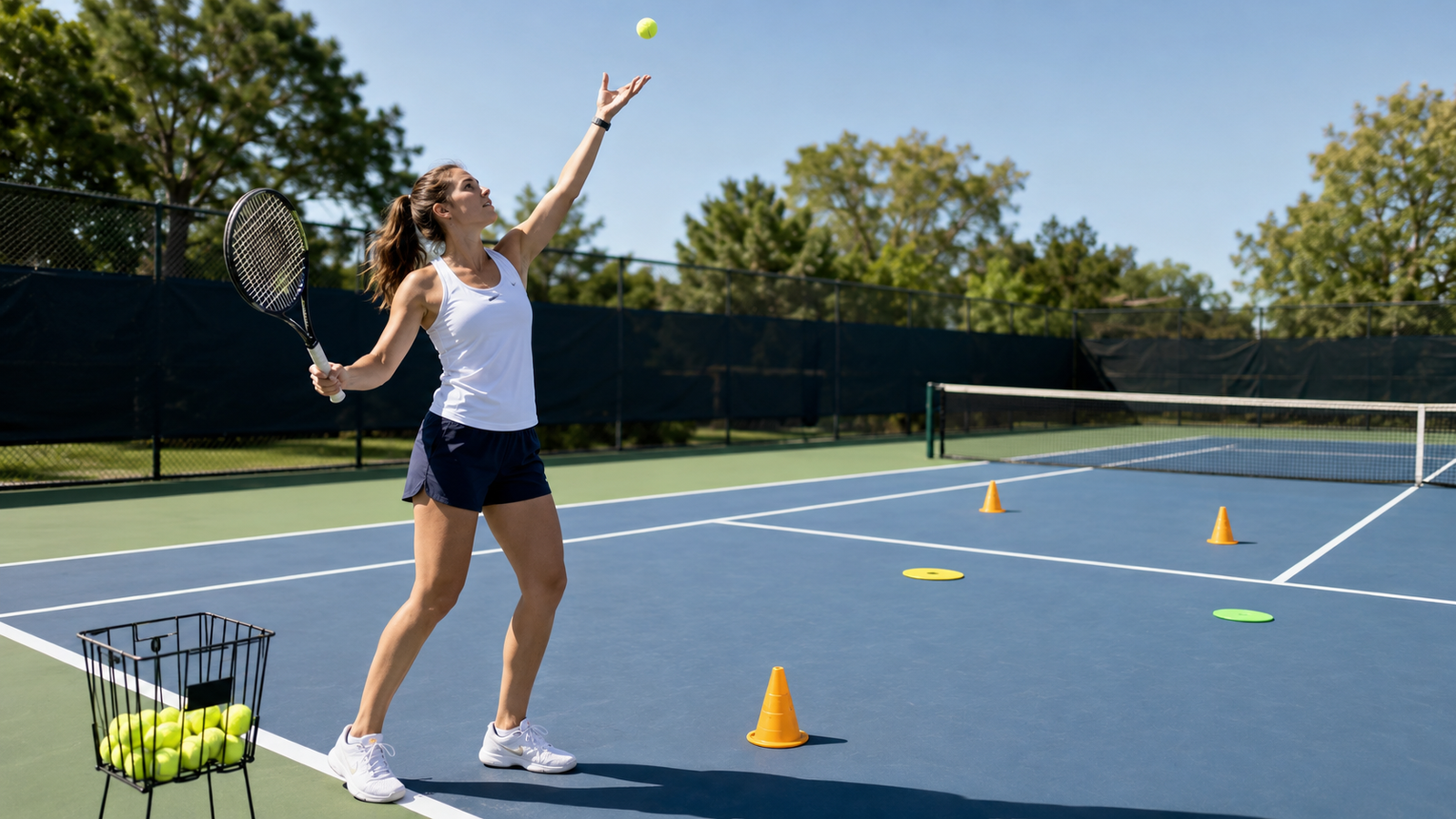
Stand in your serving stance with a ball in your tossing hand. Toss the ball and let it drop without swinging. The goal is to make it land slightly in front of you and a little to your hitting side.
Repeat this 20 to 30 times.
Why it works
Many beginners do too much with the toss. They flip the wrist, throw the ball too high, or release it late. This drill teaches better control.
Extra tip
After several repetitions, mark the ideal toss area with a cone or visual reference. This makes your tennis serve drills more precise.
For more toss-specific work, you should also read serve toss consistency drills for beginners because that article goes deeper into fixing one of the biggest serving problems.
3. Knee-Up Contact Drill
This is one of the most effective tennis serve drills for learning upward contact.
Start from your normal serving stance. Toss the ball and focus only on reaching up as high as possible to tap or hit it cleanly. Do not worry about power. Think “up,” not “forward and fast.”
You can even begin by serving from just inside the service line.
Why it works
Beginners often hit the serve while dropping their head or collapsing their body. This drill teaches extension and better contact height.
Coaching cue
Imagine you are trying to hit the ball at the highest point you can comfortably reach.
4. Half-Speed Serve Drill
Trying to serve at full speed too early usually damages technique. One of the smartest tennis serve drills is simply slowing everything down.
Hit 10 to 15 serves at about 50% effort. Focus on:
- Smooth rhythm
- Clean toss
- Balanced finish
- Getting the ball in
Then move to 60% and 70% effort only if your form still feels controlled.
Why it works
A slow serve with proper form teaches better habits than a fast serve with poor mechanics.
This is especially useful in beginner serve practice because it helps you connect all parts of the motion naturally.
5. Target Box Accuracy Drill
Place cones, towels, or markers inside the service box. Your job is not just to get the ball in, but to aim at a specific area.
Start with large targets. Then make them smaller as you improve.
Do:
- 10 serves wide
- 10 serves to the body
- 10 serves toward the T
Why it works
Accuracy-based tennis serve drills teach intention. Instead of just hoping the ball lands in, you learn to serve with purpose.
Beginner goal
Do not chase perfect placement yet. First aim for broad zones, not tiny corners.
6. Service Line Rhythm Drill
Stand closer to the net, around the service line, and hit relaxed serves into the opposite service box. Because the distance is shorter, you do not need much power.
This lets you focus on:
- Toss timing
- Smooth swing
- Clean contact
- Spin and control
Why it works
This is one of the safest tennis serve drills for building confidence. Shorter distance removes pressure and makes the serve feel more manageable.
Once you are consistent, gradually move back toward the baseline.
7. 10-in-a-Row Consistency Challenge
Consistency matters more than occasional good serves. This drill is simple: try to make 10 serves in a row into the correct box.
If you miss, start over.
Why it works
This drill adds pressure in a useful way. It teaches focus, patience, and routine.
A lot of beginners can make 4 or 5 good serves, but they struggle to repeat it under mental pressure. This type of tennis serve drills builds real match confidence.
8. Second Serve Confidence Drill
Many beginners fear the second serve more than the first. The answer is not to push the ball timidly. It is to use a safer motion with good margin.
Hit 20 second serves with:
- Slightly less speed
- A higher net clearance
- A smooth upward swing
- A reliable toss
Why it works
This drill helps you trust a controlled serve under pressure. In beginner serve practice, confidence often improves faster when players learn a dependable second serve first.
9. Serve + Ready Position Drill
A serve is not finished when the racket touches the ball. You must recover and prepare for the next shot.
Serve the ball, then immediately return to a ready position. Split step and imagine the return coming back.
Why it works
This is one of the most practical tennis serve drills because it connects technique with real play. Beginners often admire their serve too long and forget to recover.
10. Basket Repetition Drill
If you have several balls, use them. Serving one ball at a time is fine, but baskets create much better rhythm.
Try this routine:
- 10 shadow serves
- 20 toss-only reps
- 20 half-speed serves
- 20 target serves
- 10 second serves
Why it works
Repetition is everything. The best tennis serve drills work even better when they are done in an organized sequence.
A Simple Weekly Serve Practice Routine
Here is a no-coach routine beginners can follow:
Day 1: Mechanics
- 15 shadow serves
- 25 toss-only reps
- 20 half-speed serves
Day 2: Accuracy
- 10 warm-up serves
- 30 target serves
- 10 second serves
Day 3: Consistency
- 15 service-line serves
- 20 baseline serves
- 10-in-a-row challenge
This kind of beginner serve practice keeps improvement steady without making the serve feel overwhelming.
Common Mistakes Beginners Make During Serve Practice
Even with good tennis serve drills, progress slows down when beginners repeat the wrong habits.
Tossing too high
A very high toss makes timing harder.
Trying to hit too hard
Power without control usually leads to frustration.
Practicing while tired
Serving with bad form teaches bad habits.
Ignoring the follow-through
A serve should finish naturally into the court.
Changing too many things at once
Fix one issue at a time. Usually the toss and contact point should come first.
Beginners often improve faster when they focus on consistency before power, a principle commonly supported in official beginner tennis instruction.
How to Know Your Serve Is Improving
Your serve is getting better if:
- You double fault less often
- Your toss lands in a repeatable spot
- You can hit 10 or more serves with similar rhythm
- You feel balanced after contact
- You can aim to different parts of the box with more control
The purpose of tennis serve drills is not just to make your serve look better. It is to make it more dependable in real games.
Final Thoughts
The serve can feel difficult at first, but it improves much faster when you simplify your training. You do not need a coach at every session to get better. You need the right structure, enough repetitions, and patience with the process.
Start with toss control, rhythm, and clean contact. Then build consistency before chasing power. The best tennis serve drills for beginners are not flashy. They are repeatable, easy to track, and focused on the fundamentals that matter most.
If you stay consistent with these tennis serve drills, your serve will become more reliable, more relaxed, and much more match-ready over time.