

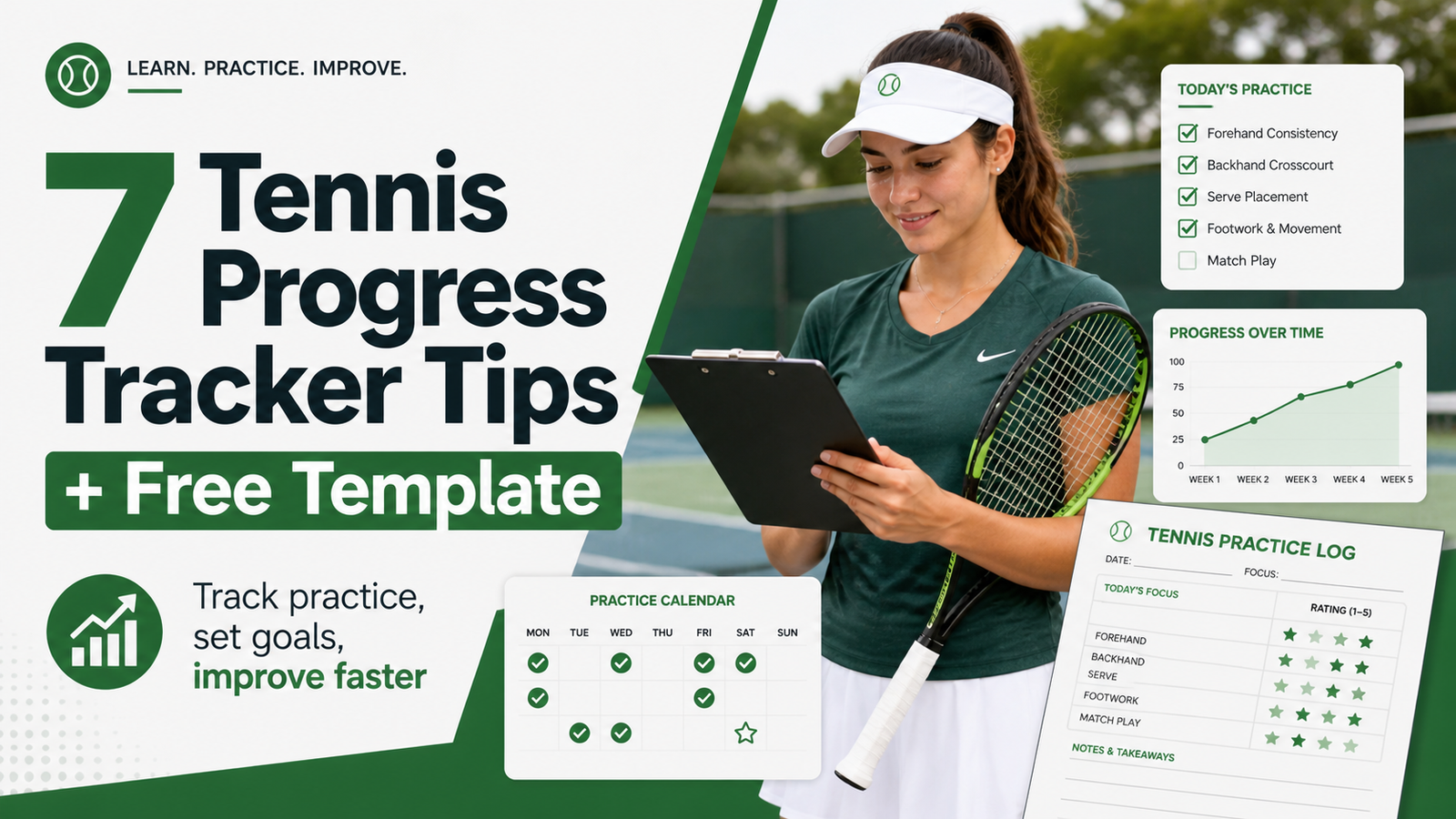
If you want to improve faster, a tennis progress tracker can make a huge difference. Many beginners practice often but still feel stuck because they do not measure what is actually improving. A simple tennis progress tracker helps you see patterns, set goals, and stay motivated over time.
Instead of guessing whether your serve, footwork, or consistency is improving, you can record your practice sessions and match results in a simple tracking system. This gives you a clear picture of where you are getting better and what still needs work. For beginners especially, this kind of approach turns random practice into smart practice.
If you are following a structured beginner path, pair this article with our 30-Day Tennis Beginner Improvement Plan so your tracking matches your weekly goals.
Why a Tennis Progress Tracker Matters
A tennis progress tracker helps you measure improvement in a practical way. Tennis is a skill-based sport, so progress does not always feel obvious from session to session. One day your forehand feels great, and the next day your timing disappears. Without a system, it is easy to lose confidence.
Here is why using a tennis progress tracker works so well:
- It shows real progress over time
- It keeps your practice focused
- It helps you spot weak areas early
- It improves motivation
- It makes goal-setting easier
A good tennis improvement chart also helps you separate emotion from performance. Maybe you felt bad during practice, but your rally count improved from 8 shots to 14 shots. That is real progress. A tennis improvement chart gives you evidence, not just feelings.
What Should You Track in Tennis?
The best tennis progress tracker is simple, useful, and easy to update. If it becomes too detailed, you will stop using it. Start with the basics and add more only when needed.
Here are the most important things to track:
1. Practice Frequency
Record how many days per week you practice. Consistency matters more than random long sessions.
2. Serve Percentage
Track how many first serves land in. For beginners, even a rough percentage is helpful.
3. Rally Length
Measure how many balls you can keep in play with a partner or against a wall.
4. Forehand and Backhand Confidence
Rate each shot from 1 to 10 after practice.
5. Footwork
Note whether your movement felt balanced, slow, rushed, or controlled.
6. Match Results
If you play points or matches, track the score and what happened well or poorly.
7. Main Lesson Learned
After every session, write one clear takeaway.
These categories make you practical without being complicated. Over time, your tennis improvement chart will help you see trends much more clearly than memory alone.
Free Tennis Progress Tracker Template
Below is a simple template you can copy and use.
Weekly Template
| Date | Practice Type | Duration | Serve In % | Rally Count | Forehand Rating (1–10) | Backhand Rating (1–10) | Footwork Rating (1–10) | Match/Drill Notes | Main Improvement Goal |
|---|---|---|---|---|---|---|---|---|---|
| May 1 | Solo wall practice | 30 min | — | 18 | 6 | 5 | 6 | Better rhythm on forehand | Improve backhand timing |
| May 3 | Coach lesson | 60 min | 48% | 10 | 6 | 6 | 5 | Learned split step basics | Move earlier to the ball |
| May 5 | Practice match | 45 min | 52% | 7 | 7 | 5 | 6 | Missed many returns under pressure | Stay relaxed on return |
| May 7 | Serve + footwork drills | 25 min | 58% | — | 6 | 5 | 7 | Toss was more stable today | Keep serve toss consistent |
This basic tennis progress tracker is enough for most beginners. If you want more detail, turn it into a monthly tennis improvement chart by adding these extra columns:
- Unforced errors
- Double faults
- Net approaches
- Return success rate
- Fitness level
- Confidence level before and after practice
How to Use a Tennis Improvement Chart Properly
A tennis improvement chart should not be used just to collect numbers. It should help you make better decisions. That is the main goal.
Here is the right way to use it:
Track the Same Metrics Each Week
Do not change what you measure every few days. If your tennis progress tracker keeps changing, you cannot compare results properly.
Focus on 3 to 5 Core Areas
Too much data creates confusion. A smart tennis improvement chart focuses on the skills that matter most for your stage.
Review Every 7 Days
At the end of each week, check your tennis progress tracker and ask:
- What improved?
- What stayed the same?
- What got worse?
- What should I focus on next week?
Use Notes, Not Just Numbers
If your rally count drops, write why. Maybe it was windy, maybe you were tired, or maybe you were trying a new grip. Notes make the tennis improvement chart more useful.
Best Metrics for Beginners to Track
If you are new to tennis, do not overcomplicate your tennis progress tracker. These beginner-friendly metrics are enough:
- Number of practice sessions per week
- Forehand consistency
- Backhand consistency
- Serve percentage
- Rally length
- Footwork confidence
- One weekly goal
- One weekly win
This approach keeps your tennis progress tracker realistic and sustainable. The goal is not perfection. The goal is awareness. If you are new to the sport, official beginner resources can also help you understand what skills matter most at the early stage.
Common Mistakes When Using a Tennis Progress Tracker
Even a well-made tennis progress tracker will not help if you use it the wrong way. Here are the most common mistakes beginners make.
1. Tracking Too Much
Trying to track 20 different things is exhausting. Keep it simple.
2. Updating It Inconsistently
If you fill out your tennis progress tracker only once every three weeks, it loses value.
3. Focusing Only on Match Wins
Wins matter, but improvement matters more. A player can lose a match and still make great progress.
4. Ignoring Notes
Your comments often explain the numbers. That is why a tennis improvement chart should include quick observations.
5. Expecting Perfect Progress
Improvement is not linear. Some weeks are better than others. Your tennis progress tracker should show long-term growth, not daily perfection. Structured practice and long-term player development are important for building better habits over time.
How to Turn Tracking Into Faster Improvement
The real power of a tennis progress tracker comes from action. After recording your results, you need to respond to them.
For example:
- If your serve percentage stays low for 3 weeks, spend more time on serve toss drills
- If your rally count improves but your match performance does not, work on pressure situations
- If your footwork rating stays low, add movement drills before every session
- If your backhand is always weaker, make it your weekly priority
This is where your tennis improvement chart becomes a coaching tool. It helps you train with purpose instead of repeating the same habits.
To make your practice more structured, combine your tracking with a daily system like our 20-Minute Daily Tennis Practice Routine for Beginners. It is a smart way to turn your notes into action.
Sample Weekly Review Using a Tennis Progress Tracker
Here is an example of how a beginner might review a week:
Week Summary
- Practiced 4 times
- Serve percentage improved from 46% to 56%
- Rally count improved from 9 to 14
- Forehand confidence stayed steady at 6/10
- Backhand dropped from 6/10 to 5/10
- Footwork improved from 5/10 to 7/10
Conclusion
- Serve and movement are improving
- Backhand needs extra focus next week
- Add 10 minutes of backhand shadow swings and wall practice
- Keep current footwork drills
This is exactly how a tennis progress tracker should work. It gives you direction. A good tennis improvement chart does not just describe your week. It helps shape the next one.
Digital vs Paper Tracker: Which Is Better?
Both options work, and the best choice depends on your style.
Digital Tracker
Best for:
- Google Sheets or Excel users
- Automatic averages
- Easy monthly comparison
- Long-term storage
Paper Tracker
Best for:
- Quick handwritten notes
- Simplicity
- Players who dislike screens during practice
A digital tennis progress tracker is better if you want to build a full tennis improvement chart over months. A paper version is better if you want something fast and easy after each practice.
Monthly Tennis Progress Tracker Goals
At the end of each month, review your tennis progress tracker using these questions:
- Did I practice as often as planned?
- Which stroke improved the most?
- Which skill still needs the most attention?
- Am I moving better on court?
- Is my confidence improving?
- What is my next monthly goal?
This monthly review turns your tennis improvement chart into a long-term growth system. Over 3 to 6 months, the progress becomes much easier to see.
Final Thoughts
A simple tracking system is one of the easiest ways to improve smarter. It helps you stay consistent, measure what matters, and build confidence with real proof of progress. You do not need a coach, expensive software, or advanced statistics to start. Even a basic template with a few useful categories can already change how you practice.
The key is consistency. Use your tennis progress tracker after every session, review it weekly, and adjust your goals based on what you see. Over time, your tennis improvement chart will show you something powerful: even small improvements add up when you practice with purpose.
If you are serious about improving step by step, start with a simple tracker today, follow a clear weekly plan, and keep your training focused.