
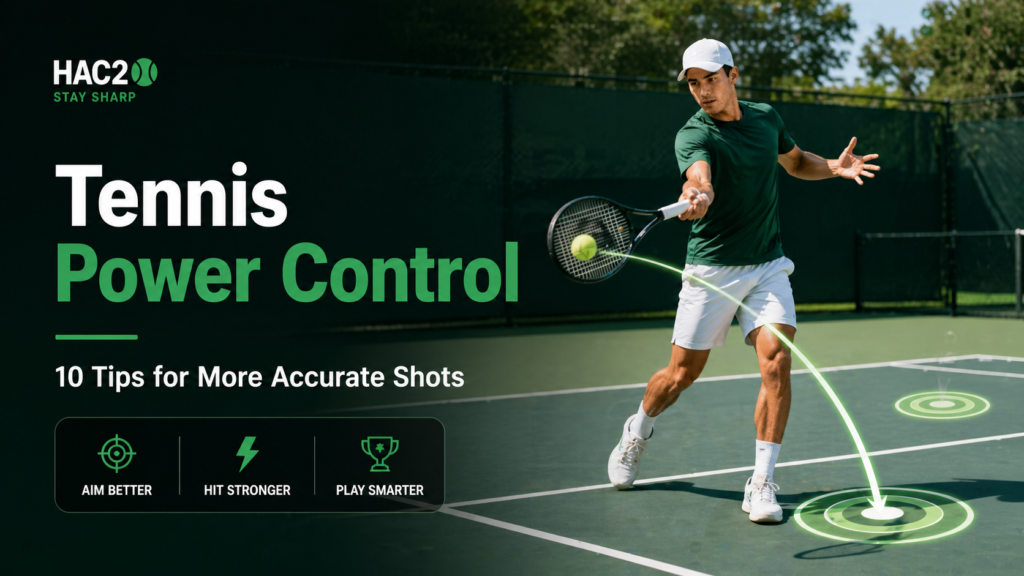
Tennis power control helps beginners hit with better pace, balance, and direction. Tennis power control is one of the most important skills for beginners who want more consistent and accurate shots. Many new players struggle to find the right balance between pace and placement, often hitting too hard or too softly. Learning tennis power control helps you hit cleaner shots, stay in rallies longer, and build confidence on the court.
If you are struggling to keep the ball in the court, the good news is that this problem is very common and very fixable. You do not need to swing harder to play better tennis. In fact, most beginners improve faster when they learn how to hit the ball cleanly, move well, and aim with purpose instead of trying to overpower every shot.
Before working on power control, it helps to build a strong technical base. If you have not already done so, start with How to Hit a Forehand in Tennis (Step-by-Step for Beginners) and How to Hit a Backhand in Tennis (One-Hand vs Two-Hand), because both articles will help you understand the mechanics behind more controlled groundstrokes.
Why Tennis Power Control Matters for Beginners
Tennis power control is a skill that improves shot consistency without forcing extra pace. Most new players think power comes from swinging as fast as possible. That usually leads to rushed timing, poor contact, and too many errors. Accuracy also becomes difficult when your body is off balance, your racquet face is unstable, or your target changes at the last second.
Here are the most common reasons beginners lose control in their shots:
- swinging too hard
- hitting while off balance
- making contact too late or too early
- using too much arm and not enough body rotation
- aiming too close to the lines
- poor footwork before contact
- not finishing the swing properly
The solution is not to become passive. The goal is to learn controlled acceleration. That means swinging with intention, staying balanced, and directing the ball to smart targets.
Power vs Accuracy in Tennis: Why You Need Both
In tennis, power without control is wasted. Accuracy without enough pace can also become predictable. Good players learn to combine both. They do not hit every ball as hard as possible. They choose the right speed, shape, and direction depending on the situation. Good tennis power control is not about hitting harder. It is about using the right amount of pace for each shot.
Think of it like this:
- Power helps you push the opponent back and create pressure.
- Accuracy helps you keep the ball in play and place it where you want.
- Control is what lets you use both at the right time.
For beginners, accuracy should come first. Once you can rally consistently and place the ball with more confidence, adding extra pace becomes much easier.
1. Focus on Clean Contact First
The fastest way to improve both power and accuracy is to hit the ball more cleanly. Clean contact means the ball meets the center of the strings with a stable racquet face and good timing.
When contact is clean:
- the ball travels more efficiently
- you do not need to force power
- your shot direction becomes easier to predict
- your body stays more relaxed
A lot of beginners try to create power with tension. That usually makes contact worse. Instead, stay loose in the hand and arm, track the ball carefully, and let the racquet do the work.
2. Use Your Body, Not Just Your Arm
If you only use your arm, your shots will feel rushed and inconsistent. Real control comes from using the whole body together. Your legs, hips, torso, shoulder, and arm should all work as one chain.
This is especially important on both the forehand and backhand. When your tennis power control improves, your forehand and backhand become more reliable under pressure. If you want a stronger base for this, review How to Hit a Forehand in Tennis (Step-by-Step for Beginners) and How to Hit a Backhand in Tennis (One-Hand vs Two-Hand) to sharpen your stroke mechanics.
To use your body properly:
- bend your knees before the shot
- turn your shoulders early
- transfer weight into the ball
- rotate through the shot smoothly
- finish in balance
When your body drives the shot, you can hit with more pace while staying under control.
3. Stop Trying to Hit Every Ball at Full Power
This is one of the biggest beginner mistakes. Tennis is not about maximum power on every swing. It is about using the right amount of power for each ball.
Try thinking in percentages:
- easy rally ball = 50% to 60% pace
- neutral groundstroke = 60% to 75% pace
- attacking ball = 75% to 85% pace
Very few shots need 100% effort. Most of the time, controlled pace wins more points than reckless power. When you swing within yourself, your timing improves and your shot shape becomes more reliable.
4. Aim for Bigger Targets
If you want more accuracy, stop aiming at the lines all the time. Beginners make life much harder by trying to hit tiny targets. A smarter approach is to aim deep and crosscourt with plenty of margin.
Better targets for beginners include:
- 3 to 5 feet inside the baseline
- 3 to 4 feet inside the sidelines
- crosscourt over the lower part of the net
- middle third of the court when under pressure
This gives you more room for error while still keeping your opponent moving. Smart placement is far more useful than low-percentage winners.
5. Improve Your Footwork Before Every Shot
Power and accuracy both start with positioning. If your feet are late, your swing usually breaks down. Poor footwork leads to awkward spacing, and awkward spacing leads to mishits.
Good footwork helps you:
- get behind the ball earlier
- create better balance
- choose your swing path more clearly
- recover faster for the next shot
Do not wait for the ball to come to you. Move your feet early, take small adjustment steps, and make sure the ball is in a comfortable hitting zone.
6. Control the Racquet Face
A slightly open or closed racquet face can completely change where the ball goes. Many beginners do not realize that small changes in racquet angle have a huge effect on both direction and height.
If your ball keeps flying long, the racquet face may be too open at contact. If you keep hitting into the net, you may be too closed or hitting too flat without enough lift.
To improve racquet-face control:
- prepare early
- keep the wrist stable through contact
- do not flick at the ball
- finish the swing fully
- watch the ball onto the strings
The more stable the racquet face is, the more predictable your shots become.
7. Use Spin to Add Safety
Spin helps bridge the gap between power and accuracy. A little topspin allows you to swing faster while still bringing the ball down into the court. That is why players who hit with shape often look more controlled than players who hit flat and hard.
You do not need extreme topspin as a beginner. Even a moderate upward brushing motion can add safety and depth. Spin gives you a better net clearance and helps the ball dip inside the baseline.
8. Stay Relaxed Under Pressure
Tension ruins control. When players get nervous, they often squeeze the racquet tighter, shorten the swing, or rush the shot. This makes the ball harder to direct.
Try these simple relaxation cues:
- exhale during contact
- keep your grip pressure moderate
- loosen the shoulders between points
- trust your swing instead of steering the ball
A relaxed swing is usually a more accurate swing.
9. Choose the Right Shot for the Situation
Not every ball should be hit with the same speed or direction. Shot selection matters. If you are stretched wide, your job is probably to recover and reset the rally. If you get a short ball, then you can be more aggressive.
Beginners improve faster when they ask:
- Am I balanced?
- Is this ball attackable?
- Should I go crosscourt or down the middle?
- Do I need more height and safety here?
Controlling power and accuracy is not only technical. It is also tactical.
10. Practice With Simple Progressions
Players can build tennis power control through repetition, balance, and smart target-based practice. The best way to improve is to train one variable at a time. Do not try to fix power, accuracy, footwork, and spin all at once in a single session.
A simple beginner progression looks like this:
Stage 1: Consistency
Rally slowly and focus only on making clean contact.
Stage 2: Placement
Aim crosscourt with safe net clearance and repeatable targets.
Stage 3: Controlled Pace
Gradually increase swing speed without losing balance.
Stage 4: Pressure Training
Add movement, recovery, and directional changes.
If you want a drill-based next step, your best internal follow-up here is Top 10 Ball Control Drills for Accuracy & Placement because it directly supports the placement and consistency skills discussed in this article.
Beginner Drills to Improve Shot Control
Here are a few easy practice ideas you can use right away:
Crosscourt Deep Target Drill
Place targets a few feet inside the baseline and rally crosscourt. Focus on height, shape, and depth rather than speed.
70% Pace Rally Drill
Rally at controlled pace and try to keep 10 to 20 balls in play. This teaches you to swing with rhythm instead of forcing the ball.
Middle-Third Control Drill
Hit through the middle of the court during neutral rallies. This improves consistency and reduces unforced errors.
Height-Over-Net Drill
Try clearing the net by several feet on every ball. This adds safety and helps you understand spin and trajectory.
Accuracy Ladder Drill
Aim first to a large area, then a medium area, then a smaller area. This trains precision in stages.
For more structured follow-up practice, link this article to Top 10 Ball Control Drills for Accuracy & Placement as planned in your cluster map.
Common Beginner Mistakes to Avoid
Beginners who learn tennis power control early usually make fewer unforced errors and build confidence faster. A lot of players delay improvement because they repeat the same errors every time they practice. Watch out for these common problems:
Hitting Too Hard Too Soon
You do not need maximum pace to improve. Control first, pace second.
Standing Too Upright
Without knee bend and balance, timing becomes much harder.
Over-Aiming
Trying to paint the lines causes more errors than winners at beginner level.
Steering the Ball
Do not push the racquet toward the target. Swing naturally and trust your mechanics.
Ignoring Recovery
Good shots are easier when you recover well after the previous one.
How to Know You’re Improving
You are getting better at controlling power and accuracy when:
- more rally balls land deep in the court
- you can change direction without panic
- your errors become more predictable
- you feel less rushed on neutral balls
- you can hit with moderate pace and still stay consistent
Improvement does not mean every shot is perfect. It means your average ball becomes more dependable.
Final Thoughts
Learning how to control power and accuracy in tennis shots is one of the most important steps for any beginner. Over time, tennis power control becomes one of the key foundations of accurate and confident shot-making. It is what turns wild swings into reliable strokes and random rallies into smart tennis. You do not need to hit harder than everyone else. You need to hit cleaner, move better, choose safer targets, and build your shots with confidence.
Tennis power control also improves depth, placement, and overall rally consistency. Start by focusing on balance, clean contact, and controlled pace. Then gradually add placement and spin. Over time, you will notice that your shots feel more natural, your rally length increases, and your confidence grows.
To strengthen the technical side of this topic, connect this article internally with [How to Hit a Forehand in Tennis (Step-by-Step for Beginners)] and [How to Hit a Backhand in Tennis (One-Hand vs Two-Hand)]. Then guide readers into practice mode with [Top 10 Ball Control Drills for Accuracy & Placement] so the cluster flows exactly as planned.