
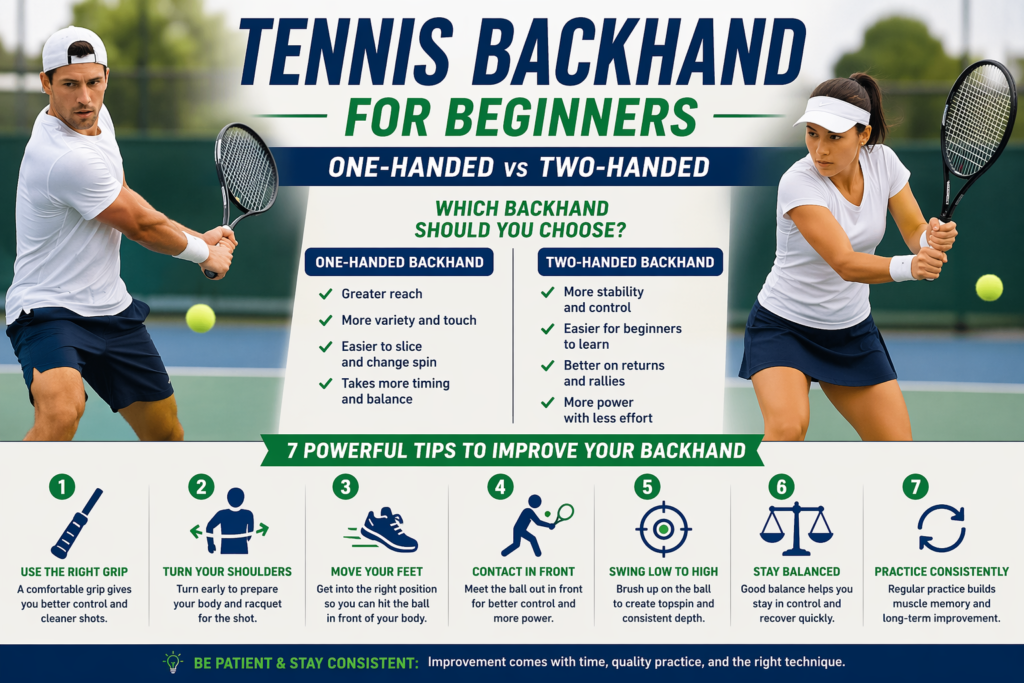
Tennis backhand beginners often struggle with timing, balance, and clean contact, especially when learning the difference between a one-handed and two-handed backhand. Tennis backhand beginners often struggle with timing, balance, and clean contact, especially when deciding between a one-handed and two-handed backhand. The good news is that with the right technique, simple footwork, and consistent practice, this shot can become one of the most reliable parts of your game.
If you are still working on the fundamentals, start with this guide on how to hold a tennis racquet correctly, because your grip has a huge impact on how cleanly you hit the ball. It also helps to understand the basic swing path used on the forehand side, so you may also want to read how to hit a forehand in tennis before fully building your backhand technique.
In this guide, you will learn what a tennis backhand is, the difference between a one-handed and two-handed backhand, and how beginners can develop a more consistent, confident stroke.
Tennis Backhand Beginners: One-Hand vs Two-Hand Basics
For most tennis backhand beginners, the two-handed backhand is easier to control during rallies and return shots. A backhand is the shot you hit on the opposite side of your dominant hand. For a right-handed player, the backhand is usually hit on the left side of the body. For a left-handed player, it is hit on the right side.
There are two main types of backhands in tennis:
- Two-handed backhand
- One-handed backhand
Both styles can be effective. Many beginners start with a two-handed backhand because it offers more control and stability. A one-handed backhand can also be a beautiful and powerful shot, but it usually takes more timing, balance, and strength to master.
1 Hand vs Two Hand Backhand
Before learning the technique, it helps to understand the difference between the two styles.
Two-Handed Backhand
A two-handed backhand uses both hands on the racquet. This is the most common choice for beginners because it gives extra control and makes it easier to handle fast balls.
Benefits of a two-handed backhand:
- More stability
- Easier for beginners to learn
- Better control on returns and rallies
- Helps generate power without over-swinging
Challenges:
- Slightly less reach
- Can feel restricted on wide balls
- Requires both hands to stay connected through the shot
One-Handed Backhand
A one-handed backhand uses only the dominant hand to swing through the ball, while the non-dominant hand helps guide the racquet during preparation.
Benefits of a one-handed backhand:
- Greater reach
- More variety and touch
- Easier to slice and change spin
- Can feel more fluid once developed
Challenges:
- Harder for beginners
- Requires stronger timing and balance
- Less forgiving under pressure
For most beginner players, the two-handed backhand is the easier starting point. Still, if a one-handed backhand feels more natural to you, there is nothing wrong with developing that style early.
Which Backhand Is Better for Beginners?
For most new players, the two-handed backhand is usually the better option. It is more stable, easier to repeat, and more forgiving when timing is not perfect.
A beginner often struggles with:
- Late contact
- Weak contact point
- Poor balance
- Racquet face control
Using two hands can solve many of these early problems. That said, the best backhand is the one you can hit with confidence and consistency. If you are comfortable with a one-hander and willing to practice it properly, that can still work well in the long term.
If you are new to the game, it also helps to review the official beginner resources from USTA.
How to Hit a Two-Handed Backhand
Let’s start with the shot most beginners learn first.
1. Start With the Right Grip
Your dominant hand usually stays in a continental or mild backhand grip, while the non-dominant hand helps drive the shot. Grip comfort matters a lot, so make small adjustments until the racquet face feels stable through contact.
2. Turn Your Shoulders Early
As soon as you recognize the ball is coming to your backhand side, turn your shoulders and hips. This early unit turn prepares the racquet and helps you avoid rushed swings.
3. Set the Racquet Back
Keep the racquet back with your hands together and the head slightly above your hands. Stay relaxed. Do not overcomplicate the backswing.
4. Move Your Feet
Getting into position is one of the biggest keys to a successful backhand. Try to move so the ball is slightly in front of your body when you make contact.
5. Step Into the Shot
Use your legs and body rotation to drive through the ball. Beginners often try to use only their arms, but power should come from the ground up.
6. Contact in Front
Meet the ball out in front of your body, not too close to your chest. This gives you more control and helps you swing through the shot.
7. Finish High
After contact, continue the swing and finish high. A full follow-through improves topspin, balance, and consistency.
How to Hit a One-Handed Backhand
A one-handed backhand needs more timing and body control, but it can be highly effective.
1. Use a Backhand Grip
Most players use an eastern backhand grip or a variation that supports clean contact and topspin.
2. Turn Early
Preparation is even more important on a one-handed backhand. You need time to set the racquet and align your body.
3. Keep Your Non-Dominant Hand Active
Use your non-dominant hand on the throat of the racquet during setup. This keeps the racquet steady and helps your shoulders turn fully.
4. Create Space
A one-handed backhand needs enough room for the arm to extend. If the ball gets too close to your body, the shot becomes weak and cramped.
5. Swing Low to High
To produce topspin and lift the ball safely over the net, swing from low to high.
6. Extend Through the Ball
Do not chop at the shot. Reach through the contact zone and allow the racquet to continue naturally.
7. Stay Balanced
A one-handed backhand breaks down quickly when your feet are lazy or your head moves too much. Stable balance is essential.
Common Beginner Backhand Mistakes
Many tennis backhand beginners swing too late, stand too close to the ball, or rely only on arm strength. Most beginner backhands improve faster when a few simple mistakes are fixed early.
Hitting Too Late
Late contact is one of the biggest reasons backhands feel weak or awkward. Turn early and get your feet moving sooner.
Standing Too Close to the Ball
If the ball jams you, your swing becomes cramped. Create space so you can swing freely.
Using Only the Arms
Your backhand should not come from just the arms. Use your shoulders, hips, and legs to support the shot.
Opening Up Too Soon
If your chest opens too early, you lose control and direction. Stay turned through contact.
Forcing Too Much Power
Many beginners try to hit hard before learning clean contact. Focus on timing, balance, and control first. Power will come later.
Backhand Footwork Tips for Beginners
Your backhand gets much easier when your feet do their job.
Try these simple habits:
- Split step before your opponent hits
- Turn as soon as you read the ball
- Shuffle into position instead of reaching
- Keep your knees slightly bent
- Recover quickly after the shot
Good footwork gives your backhand more time, more balance, and more consistency.
How to Practice Your Backhand
The fastest way for tennis backhand beginners to improve is by repeating simple drills with proper footwork and contact point awareness. You do not need advanced drills to improve. Start simple.
Shadow Swings
Practice the motion without a ball. Focus on turn, contact point, and follow-through.
Drop Feed Drills
Simple repetition drills are often the best way for tennis backhand beginners to build confidence and improve consistency. Drop the ball yourself and hit controlled backhands from a comfortable position.
Wall Practice
A wall is one of the best tools for building rhythm and repetition on the backhand side.
Crosscourt Rally Practice
Backhands often become more consistent when beginners rally crosscourt because the target area feels larger and safer.
Slow Controlled Reps
Do not rush. Clean, repeatable swings matter more than speed.
Common Problems Tennis Backhand Beginners Face
Many tennis backhand beginners struggle with late contact, poor balance, and weak follow-through when learning this shot.
Should You Choose One-Handed or Two-Handed?
If you are still unsure, here is the simplest answer:
Choose a two-handed backhand if you want:
- Faster beginner progress
- More stability
- Easier rallying
- Better return control
Choose a one-handed backhand if you want:
- More reach
- Greater variety
- A more natural single-arm swing
- Long-term style development
There is no perfect answer for everyone. Your body type, strength, comfort, and coaching support all play a role.
Beginners can also learn more about the structure of the game through the official resources at ITF.
Final Tips to Improve Faster
If you want a stronger beginner backhand, focus on these priorities:
- Learn the correct grip first
- Prepare early on every ball
- Move your feet before swinging
- Contact the ball in front
- Build control before power
- Practice consistently
The backhand usually takes more patience than the forehand, but it becomes much easier once your timing improves. Stay relaxed, keep your mechanics simple, and practice the shot with purpose.
Conclusion
If tennis backhand beginners stay patient and practice consistently, their backhand can become one of the most reliable shots in their game. A strong backhand can completely change the way you play tennis. Whether you choose a one-handed or two-handed backhand, the real goal is to build a repeatable motion that feels comfortable under pressure. For most beginners, a two-handed backhand offers the easiest path to consistency, while a one-handed backhand can become a great long-term weapon with enough practice.
Start with solid fundamentals, stay patient, and focus on clean contact. Over time, your backhand will stop feeling like a weakness and start becoming a shot you trust.
To build your technique properly, make sure to review how to hold a tennis racquet correctly and how to hit a forehand in tennis, since both of those guides support the backhand fundamentals in your tennis learning journey.