
Footwork for Tennis Beginners: Basics for Balance & Speed

1
tennis footwork beginners
Beginner tennis footwork practice focused on balance, speed, and movement on the court.

Tennis footwork beginners need to learn balance, movement, and recovery early if they want to improve faster on court. Good footwork helps new players reach the ball on time, stay balanced during each shot, and move with more confidence. In this guide, you will learn the basic footwork patterns, common mistakes, and simple tips to build better speed and control. Tennis footwork beginners often improve much faster when they build strong movement habits early.

Good footwork helps you get into position earlier, stay balanced during your shots, recover faster after each ball, and move with more confidence around the court. Even if your technique is still developing, better movement can instantly make you feel more in control.

In simple terms, footwork is the foundation of every shot in tennis. You can have the right grip and understand swing technique, but if your feet are late or out of position, your shot will usually suffer. That is why learning the basics of tennis movement early is so important.

In this guide, you will learn the core footwork principles every beginner should understand, the most common mistakes to avoid, and how to build better balance and speed step by step.

Tennis Footwork Beginners: Why Basics Matter

Tennis footwork beginners should focus on balance before trying to move faster. Tennis is not a stationary sport. Every point requires movement, adjustment, balance, and recovery. Even when the ball comes directly to you, small steps are often needed to get into the ideal hitting position.

Here is what good footwork helps you do:

  • Reach the ball earlier
  • Stay balanced while hitting
  • Recover faster after each shot
  • Change direction more smoothly
  • Improve shot consistency
  • Reduce rushed swings and off-balance errors

Many beginner mistakes in tennis are actually movement problems, not swing problems. Players often think they need to “fix the stroke,” when the real issue is that they are too close, too far, or too late to the ball.

If you are just getting started, read our guide on how to start playing tennis to build a strong foundation before working deeper on movement and technique.

The 5 Basic Footwork Principles for Tennis Beginners

1. Stay Light on Your Feet

One of the first things beginners should learn is to avoid standing flat-footed. In tennis, you need to stay light, alert, and ready to move in any direction.

Try to keep:

  • Your knees slightly bent
  • Your weight on the balls of your feet
  • Your body relaxed, not stiff
  • Your posture athletic and ready

This ready position makes it easier to react quickly when your opponent hits the ball.

2. Use Small Adjustment Steps

For tennis footwork beginners, small adjustment steps are often more important than big movements. Beginners often make one big move to the ball and then stop. The problem is that tennis usually requires several small adjustment steps right before contact.

These extra steps help you:

  • Fine-tune your position
  • Create better spacing from the ball
  • Stay balanced through the shot
  • Avoid reaching or crowding yourself

Think of it this way: the first move gets you close, but the small steps get you set.

3. Split Step Before Your Opponent’s Shot

The split step is one of the most important movement habits in tennis. It is a small hop or bounce you make just as your opponent is about to hit the ball. Tennis footwork beginners improve faster when they practice split step timing regularly.

This helps your body stay loaded and ready to move left, right, forward, or backward.

For beginners, the split step does not need to be dramatic. It just needs to be well-timed and controlled. Even a small bounce can improve your reaction speed.

4. Recover After Every Shot

Many tennis footwork beginners lose control because they do not recover properly after each shot. In tennis, every shot should be followed by a recovery movement so you can prepare for the next ball.

After hitting:

  • Return toward a neutral court position
  • Reset your balance
  • Prepare your feet for the next move

This habit is especially important during rallies. If you do not recover, the next shot often feels rushed.

5. Stay Balanced While You Hit

Balance is one of the hidden secrets of better tennis. A player with average technique but good balance often plays better than a player with flashy swings and poor movement.

Try to keep:

  • Your head steady
  • Your body under control
  • Your feet planted or moving smoothly into the shot
  • Your center of gravity stable

Good balance leads to cleaner contact and more consistent results.

You can also review beginner fundamentals on the USTA website.

The Most Common Beginner Footwork Patterns

You do not need advanced movement patterns to start playing better tennis. Most beginners improve a lot just by learning a few basic patterns.

Side Shuffle

The side shuffle is used when moving laterally across the court. It helps you stay balanced and face the ball while moving.

Best for:

  • Adjusting sideways during rallies
  • Recovering after wide shots
  • Staying low and ready

Crossover Step

The crossover step is helpful when you need to cover more ground quickly. It is often used on wider balls when a shuffle alone is too slow.

Best for:

  • Chasing balls hit far to the side
  • Recovering from defensive positions
  • Moving with more speed over distance

Forward Steps

You will use forward steps when approaching short balls, moving toward the net, or attacking easier shots.

Best for:

  • Approach shots
  • Volleys
  • Short balls

Backward Recovery Steps

Beginners sometimes backpedal when the ball goes deep. That can be awkward and unsafe. Instead, use controlled backward or angled recovery steps to keep balance.

Best for:

  • Deep balls
  • Lobs
  • Resetting after being pulled forward

Official rules and tennis development resources are also available from the ITF.

How Footwork Improves Balance

Balance in tennis comes from your body position, your posture, and your feet working together.

When your footwork improves, you naturally:

  • Stop reaching for the ball
  • Create more comfortable spacing
  • Hit with better posture
  • Stay more controlled under pressure

A balanced player can hit more cleanly, even if the shot itself is simple. That is why strong movement basics are often more valuable than trying to hit harder.

If you want to improve movement through practice, the next step after this article is working on beginner footwork drills to improve speed and balance.

How Footwork Improves Speed

In tennis, speed is not only about how fast you can run. It is also about:

  • How quickly you react
  • How efficiently you move
  • How early you prepare
  • How smoothly you recover

Many beginners think they are “too slow,” but often the real issue is poor movement efficiency.

For example:

  • No split step = late reaction
  • No adjustment steps = poor positioning
  • No recovery = constant scrambling
  • Stiff posture = slower first movement

So if you want to feel faster on court, work on movement habits before worrying about raw athleticism.

Tennis Footwork Beginners: Common Mistakes to Avoid

1. Standing Too Upright

A tall, stiff posture makes it harder to react. Stay low and ready.

2. Watching the Ball Without Moving Early

Do not wait until the ball is close. Start moving as soon as you read the direction.

3. Taking Only Big Steps

Big steps can get you near the ball, but small adjustment steps are what create control.

4. Forgetting the Split Step

Without the split step, your first move is often late.

5. Hitting While Off-Balance

If you are falling away from the shot, your consistency will drop.

6. Not Recovering After the Shot

Always expect one more ball. Recover after every hit.

7. Trying to Move Too Fast Too Soon

Beginners often rush. Smooth, controlled movement is better than frantic movement. A lot of tennis footwork beginners try to rush to the ball instead of moving with control and balance.

Simple Tips to Build Better Tennis Footwork

You do not need complicated training to improve. Start with these simple habits:

Practice Ready Position Every Session

Before every feed, rally, or drill, start in a proper ready stance.

Focus on the Split Step

Even if you only improve this one habit, your movement can feel much better.

Add Small Steps Before Contact

Train yourself not to hit from awkward spacing.

Recover After Every Ball

Make this automatic in practice, not just in matches.

Stay Relaxed

Tension slows movement. Keep your shoulders, arms, and legs loose.

Train Footwork Separately

Do not rely only on rallying. Isolated movement drills help a lot.

For a deeper progression, pair this guide with best footwork exercises for tennis, which can help you build speed, agility, and movement confidence off the ball.

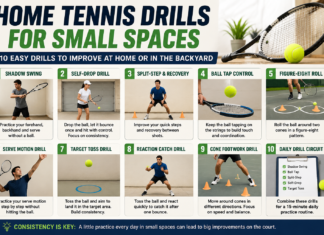
Beginner Footwork Practice You Can Do Right Away

Here is a simple practice routine you can use:

1. Shadow Movement

Without a ball, move into:

  • Forehand position
  • Backhand position
  • Recovery position

Do this slowly at first, then increase speed.

2. Split Step + First Move

Have a partner point left or right. Split step, react, and move.

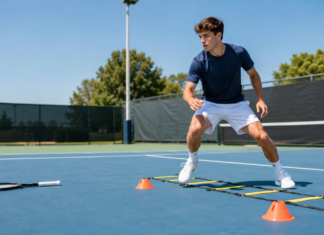
3. Side Shuffle Drill

Shuffle 3 to 5 steps, stop, set your stance, then recover.

4. Adjustment Step Drill

Move toward an imaginary ball and take 2 to 4 small steps before your “contact point.”

5. Recovery Habit Drill

After every shadow swing, return to your ready position.

Even 10 minutes of focused movement practice can make a difference.

How Often Should Beginners Practice Footwork?

For most beginners, footwork practice 2 to 4 times per week is enough to create visible improvement.

A good approach is:

  • 5 to 10 minutes before each hitting session
  • 1 or 2 dedicated movement sessions per week
  • Short, consistent reps instead of long exhausting workouts

The key is repetition. Tennis footwork improves through habit, not just effort.

Final Thoughts

Footwork for tennis beginners does not have to be complicated. You do not need advanced patterns or elite athleticism to move better on court. What you do need is a strong foundation.

Start with the basics:

  • Stay light on your feet
  • Use the split step
  • Take adjustment steps
  • Stay balanced
  • Recover after every shot

These habits will help you feel quicker, more stable, and more prepared during rallies. And once your movement improves, many other parts of your game become easier too.

If you are serious about improving your movement, continue with beginner footwork drills to improve speed and balance and best footwork exercises for tennis. For tennis footwork beginners, better balance and recovery can make every part of the game feel easier. Those articles are the perfect next step after learning the basics here.

LEAVE A REPLY

Please enter your comment!
Please enter your name here