
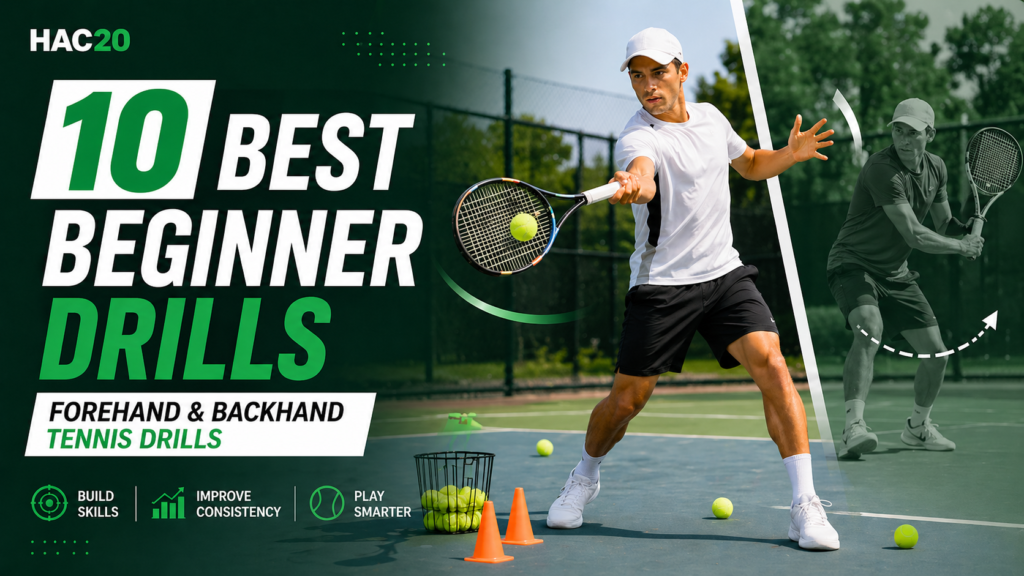
Tennis drills forehand backhand practice is one of the best ways for beginners to improve timing, control, balance, and consistency on the court. If you are new to tennis, learning how to hit a forehand and backhand consistently can feel difficult at first. Many beginners struggle with timing, balance, footwork, and control. The good news is that you do not need complicated training to improve. You need the right set of beginner-friendly drills that teach you how to move, prepare early, and make clean contact with the ball.
In this guide, you will learn 10 simple and effective forehand and backhand drills for beginners. These drills are designed to help you build confidence, improve consistency, and develop better stroke mechanics step by step. If you are still working on the fundamentals, it also helps to first understand how to hit a forehand in tennis and how to hit a backhand in tennis before adding more practice volume.
Why Tennis Drills Forehand Backhand Matter for Beginners
Tennis drills forehand backhand help beginners build better timing, cleaner contact, and more consistent groundstrokes during practice. Your forehand and backhand are the foundation of your tennis game. If you cannot rally from the baseline, it becomes much harder to build confidence in points or enjoy practice sessions. Drills help you repeat the same movement patterns over and over until they start to feel natural.
Good beginner drills can help you:
- Improve timing and contact point
- Build stroke consistency
- Develop better footwork habits
- Increase control and direction
- Gain confidence during rallies
If you are just starting out, drills are often more useful than random hitting because they give your practice structure. For a broader practice framework, check out 15 Best Tennis Drills for Beginners. And if you often train by yourself, you may also like 10 Solo Tennis Drills to Improve Without a Partner.
1. Shadow Swing Drill
This is one of the simplest and most effective ways to start improving your forehand and backhand. You do not even need a ball. Just stand in ready position and rehearse your swing slowly.
For the forehand, focus on:
- Turning your shoulders
- Dropping the racquet naturally
- Swinging from low to high
- Finishing over your shoulder
For the backhand, focus on:
- Early shoulder turn
- Stable balance
- Smooth contact path
- Controlled finish
Do 10 to 15 forehands, then 10 to 15 backhands. This drill helps you groove the movement without pressure.
2. Drop Feed Forehand Drill
In this drill, you drop the ball yourself and hit it after one bounce. It is excellent for beginners because it removes the challenge of reading a moving feed from another player.
How to do it:
- Hold the ball in your non-dominant hand
- Drop it slightly in front of you
- Let it bounce once
- Hit a controlled forehand to the other side
Focus on clean contact, balance, and finishing the swing. Do not try to hit hard. The goal is consistency and proper form.
This drill is especially useful if you are still learning the basics of forehand technique for beginners.
3. Drop Feed Backhand Drill
This is the backhand version of the previous drill and works very well for both one-handed and two-handed backhands. It teaches you to prepare early and meet the ball in front of your body.
How to do it:
- Drop the ball with control
- Turn your shoulders early
- Step into the shot
- Hit a smooth backhand after the bounce
Many beginners let the ball get too close to their body on the backhand side. This drill helps fix that habit and improves spacing.
4. Crosscourt Forehand Rally Drill
Once you are comfortable with self-feeds, move into a simple rally drill with a partner. Rally forehands only, crosscourt, at a moderate pace. Crosscourt is easier than down the line because the court is longer and gives you more room for error.
Goals for this drill:
- Keep the ball in play
- Recover to ready position after each shot
- Make contact in front of your body
- Focus on control more than power
Try to maintain a rally of 5, then 10, then 15 shots. This drill builds rhythm and confidence.
5. Crosscourt Backhand Rally Drill
This drill is the same idea as the forehand crosscourt rally, but now both players rally backhands only. This is one of the best ways to build consistency on your weaker side.
Focus on:
- Turning early
- Keeping your head steady
- Using your legs for balance
- Staying relaxed through contact
Many beginners rush the backhand. Slowing down and emphasizing control can help you improve faster than trying to force pace.
6. Alternating Forehand and Backhand Drill
Tennis drills forehand backhand training can also help beginners feel more comfortable switching between forehand and backhand during rallies. This is a great drill for learning how to switch between both sides during a rally. Have your partner feed or rally one ball to your forehand, then one to your backhand, and keep alternating.
Why it works:
- Improves footwork
- Teaches quick preparation
- Helps you recover after each shot
- Builds better court movement
At first, do this slowly. The goal is not speed. The goal is to learn how to move efficiently and stay balanced between shots.
7. Cone Target Drill for Direction Control
Place cones or markers on the court and aim your forehand and backhand toward those targets. You can set up one target crosscourt and another down the line, then practice hitting toward each one.
This drill helps beginners:
- Improve accuracy
- Learn shot direction
- Understand racquet face control
- Focus on placement instead of power
Even if you miss the target, the act of aiming improves concentration and discipline during practice.
8. Mini Tennis Control Drill
Mini tennis is one of the most underrated drills for beginners. Stand close to the service line with your partner and rally gently using compact forehands and backhands. Because you are closer to the net, you have to control the ball carefully.
Benefits of mini tennis:
- Improves touch
- Teaches clean contact
- Develops soft hands
- Encourages control over force
This drill is especially helpful before full-court hitting because it helps you feel the ball on the strings.
9. Forehand and Backhand Footwork Drill
Your strokes can only improve so much without good movement. This drill combines simple feeding with footwork recovery. A partner feeds the ball side to side, and you move to each shot while returning to the middle after every hit.
Focus on:
- Small adjustment steps
- Balanced recovery
- Early racquet preparation
- Staying light on your feet
This drill teaches you that good strokes start with good positioning. If your feet are late, your forehand and backhand will often break down too.
10. 10-Ball Consistency Challenge
This is a simple performance drill. Your goal is to hit 10 forehands in a row into the court, then 10 backhands in a row. If you miss before reaching 10, start over.
You can make it harder by:
- Aiming crosscourt only
- Using a target area
- Alternating forehand and backhand
- Increasing the number to 15 or 20 balls
This drill builds focus, patience, and discipline. It also shows you clearly where your consistency level is right now.
Tips to Get Better Results From These Drills
Tennis drills forehand backhand practice also helps beginners improve footwork, control, and shot consistency during real rally situations. Drills work best when you focus on quality instead of rushing through repetitions. Here are a few simple tips that help beginners improve faster:
Start Slow
Do not try to hit too hard. Controlled practice is much more useful than wild practice.
Focus on One Thing at a Time
For example, in one session you may focus only on contact point. In another, you may focus on balance or recovery.
Use Short Practice Blocks
Ten to fifteen minutes on one drill is usually enough for beginners. Too much repetition at once can lead to sloppy technique.
Record Yourself
A short video can help you notice mistakes in your swing, spacing, or footwork.
Practice Both Sides
Do not spend all your time on your stronger forehand. Beginners often improve faster when they give the backhand more attention.
Common Mistakes Beginners Make During Stroke Drills
Even good drills can become less effective if you repeat the wrong habits. Watch out for these common beginner mistakes:
- Swinging too hard
- Standing too upright
- Preparing too late
- Watching where the ball will go instead of watching contact
- Forgetting to recover after the shot
- Practicing without a clear purpose
How Often Should Beginners Practice These Drills?
Tennis drills forehand backhand practice works best when beginners follow a simple weekly routine and stay consistent. For most beginners, 2 to 4 practice sessions per week is enough to see progress. You do not need to do all 10 drills every time. A smarter approach is to choose 3 to 4 drills per session.
A simple weekly example:
- Session 1: Shadow swings, drop feeds, mini tennis
- Session 2: Crosscourt rallies, alternating strokes, target drill
- Session 3: Footwork drill, consistency challenge, mini tennis
This keeps your training focused and manageable. If you want more structure, pair these drills with a wider training plan from or add solo work from these solo tennis drills on days when you do not have a partner.
Final Thoughts
These tennis drills forehand backhand routines are simple, effective, and ideal for beginners who want to improve faster. Forehand and backhand improvement does not come from hitting harder. It comes from repeating the right movements, staying balanced, and building consistency one drill at a time. These 10 beginner drills are simple, practical, and highly effective for players who want to improve faster without making practice too complicated.
Start with the easiest drills first, especially shadow swings and drop feeds, then work your way into rally-based exercises and movement drills. Over time, you will notice cleaner contact, better control, and much more confidence on both wings. For beginners, tennis drills forehand backhand sessions are one of the fastest ways to build confidence on both sides of the court. If you practice these tennis drills forehand backhand regularly, you will develop more confidence on both sides.