
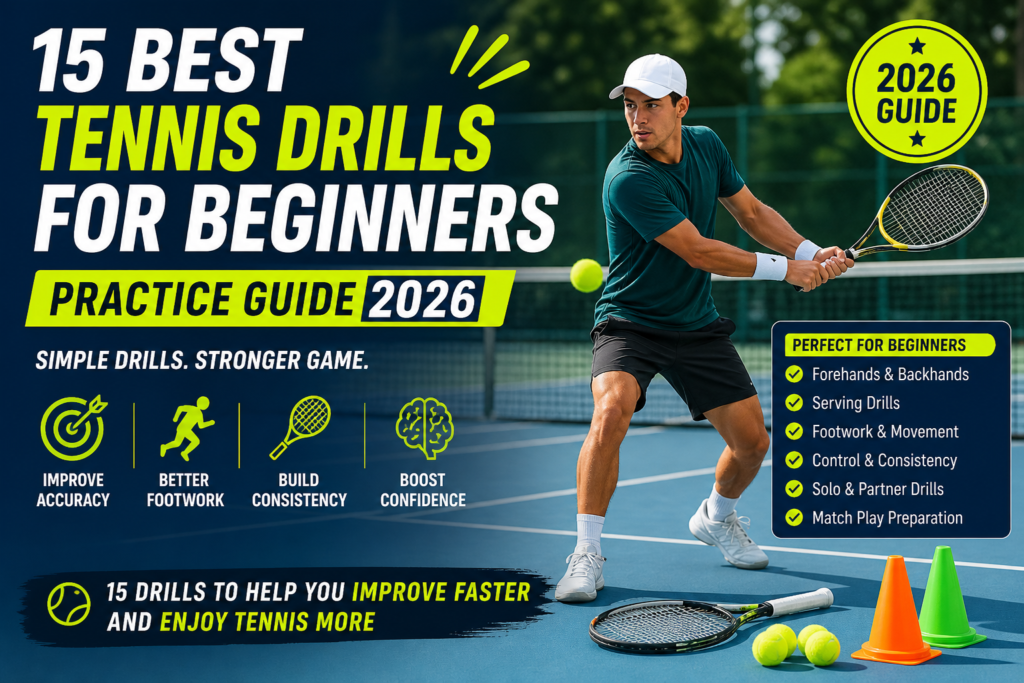
If you want to improve faster, the right tennis drills for beginners can make a huge difference. Many new players spend time hitting balls without a clear goal, but structured practice helps you build control, confidence, footwork, and consistency much faster. The best tennis drills for beginners are simple, repeatable, and focused on one skill at a time.
In this guide, you will learn 15 practical tennis drills for beginners that help with rallying, movement, timing, serving, and ball control. These drills are designed for players who are still learning the basics and want a clear way to practice without feeling overwhelmed. Whether you train alone, with a partner, or during lessons, these tennis drills for beginners will help you develop a stronger foundation for long-term progress.
Before starting, remember one thing: quality matters more than speed. Focus on clean technique, balance, and repetition. That is how tennis drills for beginners turn into real improvement on the court.
Why Tennis Drills Matter for New Players
The main reason tennis drills for beginners work so well is that they break the game into manageable pieces. Tennis can feel difficult at first because you have to think about grip, timing, footwork, contact point, recovery, and direction all at once. Drills simplify that process.
Instead of trying to play full points too early, you can use tennis drills for beginners to improve one area at a time. For example, one drill may help you watch the ball better, while another may help you move your feet more efficiently. Over time, these small improvements combine and make match play much easier.
If you are new to the sport, the USTA beginner tennis resources can also help you understand the basics of practice and player development.
How to Use These Drills Effectively
To get the most from these tennis drills for beginners, keep these rules in mind:
- Warm up for 5 to 10 minutes before starting
- Focus on control before power
- Do each drill for 3 to 5 minutes
- Rest briefly between drills
- Track what feels difficult and repeat it next session
A good practice session does not need to be long. In fact, a short and focused routine often works better. You can build one using this 20-Minute Daily Tennis Practice Routine for Beginners.
1. Mini Tennis Warm-Up Drill
Start close to the net with a partner and rally gently inside the service boxes. This is one of the most useful tennis drills for beginners because it improves touch, timing, and control without forcing you to hit hard.
Focus on:
- Soft swings
- Watching the ball
- Clean contact
- Keeping the ball low and controlled
Mini tennis teaches you how to feel the ball on the strings, which is a vital skill for every beginner.
2. Forehand Crosscourt Rally Drill
Stand on the baseline and rally crosscourt using only forehands. Crosscourt is the easiest direction for most players because the net is lower in the middle and the court is longer diagonally.
This drill helps beginners:
- Groove forehand technique
- Build rally consistency
- Improve direction control
- Learn safe shot patterns
Among all tennis drills for beginners, this one is excellent for developing rhythm.
3. Backhand Crosscourt Rally Drill
This is the backhand version of the previous drill. Rally crosscourt with controlled pace and focus on balance through the shot.
Key goals:
- Early preparation
- Stable stance
- Smooth swing path
- Recovery after each shot
Many beginners avoid the backhand, so this drill builds trust in that side and makes your game more balanced.
If you are still learning proper technique, read How to Hit a Backhand in Tennis (One-Hand vs Two-Hand) before trying to increase speed.
4. Cone Target Groundstroke Drill
Place cones or targets deep in the court and try to hit toward them with controlled forehands and backhands. This is one of the best tennis drills for beginners for learning placement instead of just hitting the ball back.
You do not need to hit the target exactly every time. The main goal is to build awareness of depth and direction.
5. Split-Step Reaction Drill
Have a partner feed balls from different directions while you practice split-stepping before moving to the ball. Footwork is often the hidden reason beginners miss easy shots, so this belongs in every list of strong tennis drills for beginners.
Focus on:
- Small jump as opponent hits
- Quick first step
- Balanced movement
- Recovery to ready position
This drill improves reaction time and court awareness.
6. Side-to-Side Footwork Drill
Set two markers several steps apart and shuffle between them while shadow swinging or receiving easy feeds. This helps you move with better balance and recover faster after each shot.
Beginners often hit one ball well and then get stuck. This drill teaches continuous movement, which is essential in real rallies.
7. Feed and Recover Drill
Have a coach or partner feed alternating forehands and backhands. After every shot, recover to the middle before moving again. This is one of the most practical tennis drills for beginners because it teaches real court habits instead of static hitting.
It helps with:
- Recovery footwork
- Shot tolerance
- Consistency under movement
- Better court positioning
8. Short Ball Approach Drill
Feed a shorter ball inside the service line and practice moving forward to attack it. Beginners often stay too far back and miss opportunities to take control of the point.
Work on:
- Recognizing a short ball
- Moving forward quickly
- Staying balanced through contact
- Recovering toward the net or middle
This drill builds confidence when transitioning from defense to offense.
9. Volley Control Drill
Stand close to the net and exchange simple forehand and backhand volleys with a partner. Keep the racket stable and use short movements. These tennis drills for beginners help players become more comfortable at the net, where many new players feel awkward.
Try to:
- Keep your wrist firm
- Punch the ball gently
- Stay on the balls of your feet
- Maintain a ready position
10. Overhead Catch-and-Hit Drill
Start by having someone toss easy lobs. First, practice moving back and catching the ball overhead. Then progress to hitting simple overheads. This is one of the safer tennis drills for beginners for learning the smash without rushing into hard shots too early.
The aim is to improve:
- Tracking high balls
- Proper positioning
- Confidence overhead
- Contact above the head
11. Serve Toss Drill
Before working on full serves, practice the toss by itself. Try to place the ball in the same spot repeatedly without swinging. A bad toss ruins even a good service motion, so this is one of the smartest tennis drills for beginners to repeat often.
You can take this further with how to hit a forehand in tennis (Step-by-Step for Beginners).
12. Half-Speed Serve Drill
After the toss drill, hit serves at about 50 to 60 percent effort. Focus on rhythm, balance, and clean contact rather than power. Beginners usually improve faster when they serve under control first.
Goals:
- Smooth motion
- Consistent toss
- Proper contact point
- Landing in the box regularly
13. Rally Count Challenge
With a partner, try to reach 5 shots, then 10, then 15 in a row. This is one of the most motivating tennis drills for beginners because progress is easy to measure. It also teaches patience, consistency, and smart shot selection.
Instead of trying winners, aim to keep the ball in play with safe margins over the net.
14. Wall Rally Drill
If you do not have a partner, use a wall. Start with slow forehands, then alternate forehands and backhands. The wall gives instant feedback and helps beginners develop timing quickly.
Wall practice improves:
- Repetition
- Hand-eye coordination
- Quick setup
- Ball tracking
It is simple, effective, and perfect for extra practice between lessons.
15. Serve + First Ball Drill
Begin the point with a serve, then play one controlled groundstroke to a target area. This connects practice to real match play. Many beginners can hit a decent serve in isolation but struggle with the next shot. These tennis drills for beginners help bridge that gap.
This drill teaches:
- Starting points with purpose
- Recovering after the serve
- Preparing for the next ball
- Building simple point patterns
For official guidance on the structure of the game, you can also review the ITF Rules of Tennis.
Sample Beginner Practice Session
To combine these tennis drills for beginners into one session, try this structure:
- 5 minutes: Mini tennis
- 5 minutes: Forehand crosscourt
- 5 minutes: Backhand crosscourt
- 5 minutes: Footwork drill
- 5 minutes: Volley control
- 5 minutes: Serve toss + half-speed serve
- 5 minutes: Rally count challenge
This gives you a complete beginner workout without making practice too complicated.
Common Mistakes When Doing Beginner Drills
Even the best tennis drills for beginners will not help much if you rush through them carelessly. Avoid these mistakes:
- Hitting too hard too soon
- Ignoring footwork
- Practicing without a clear goal
- Changing drills too quickly
- Focusing only on favorite shots
- Skipping serve practice
Consistency beats intensity at this stage. A calm, repeatable session is better than a messy one full of random hitting.
Final Thoughts
The best tennis drills for beginners are the ones that build confidence while teaching real fundamentals. You do not need advanced routines or complicated patterns to improve at the start. What you need is repetition, structure, and patience.
Use these tennis drills for beginners regularly, keep your sessions simple, and focus on steady progress. Over time, your timing, control, and movement will improve far more than if you only play casual points without purpose. As your skills grow, you can expand into more specialized practice, but this list gives you the foundation every new player needs.