
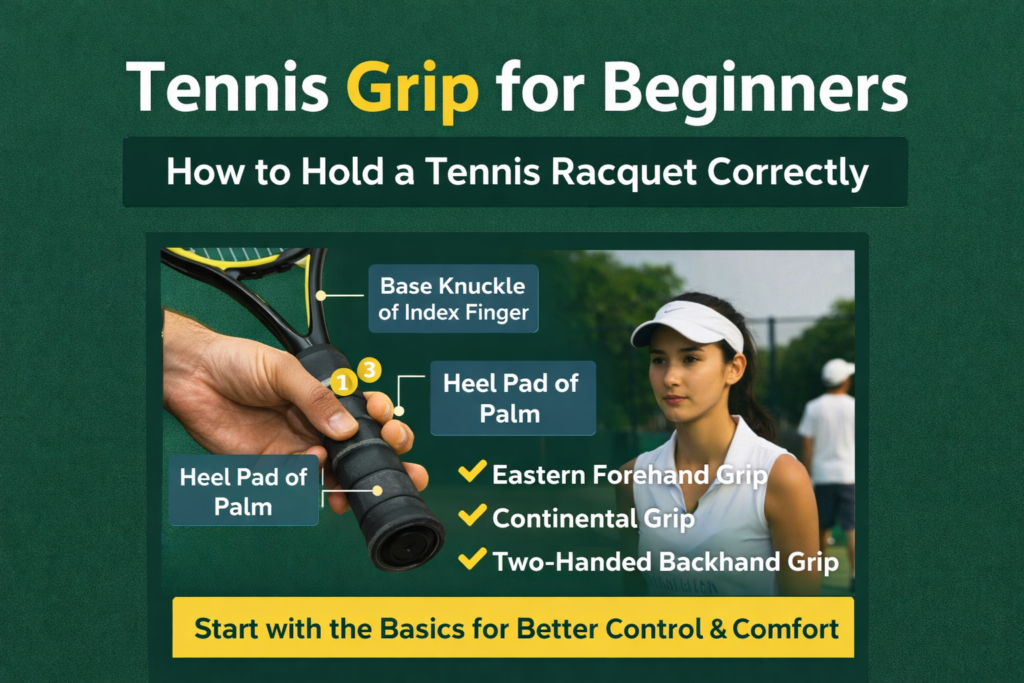
Tennis grip for beginners is one of the most important things to learn when starting tennis. A proper grip helps you control the ball, improve comfort, and build better technique from the beginning. Learning how to hold a tennis racquet correctly is one of the first and most important steps for any new player. A proper grip helps you control the ball, improve consistency, and build a strong foundation for every shot you will learn later. If your grip is off, even simple shots can feel awkward, weak, or inaccurate.
For beginners, the goal is not to memorize every advanced grip right away. It is to understand the basic hand placement, feel comfortable with the racquet, and learn how grip choice affects your forehand, backhand, serve, and volleys. Once you understand the fundamentals, it becomes much easier to improve your technique and avoid common bad habits.
If you are completely new to the sport, start with this full beginner tennis guide before moving deeper into technical skills. For official beginner instruction, the USTA beginner tennis resources offer helpful guidance on tennis fundamentals.
Why Tennis Grip for Beginners Matters
Your grip is the connection between your hand and the racquet. It affects:
- shot control
- ball direction
- topspin potential
- power
- comfort
- injury prevention
A beginner with a correct grip usually improves faster than someone who swings harder with poor hand placement. Good grip fundamentals also make it easier to learn the next steps, like a proper tennis forehand for beginners and a reliable beginner backhand technique.
The Basic Parts of a Tennis Racquet Handle
Before learning grips, it helps to understand the handle shape.
A tennis racquet handle is not perfectly round. It has 8 bevels, or flat sides. These bevels help players place their hand in specific positions. Different grips are created by placing the base knuckle of your index finger and the heel pad of your hand on different bevels.
You do not need to memorize all 8 bevels immediately, but you should know this:
- the handle shape guides your hand position
- each grip is built around bevel placement
- small hand changes can create big shot differences
The Hand Positions You Need to Know
When coaches talk about tennis grips, they usually focus on two contact points:
1. Base Knuckle of the Index Finger
This is the main reference point for your grip.
2. Heel Pad of Your Palm
This helps stabilize the racquet and supports grip control.
For beginners, these two points should usually match on the same bevel. That makes the grip easier to repeat and easier to feel.
The Most Common Tennis Grips for Beginners
There are several grips in tennis, but beginners should focus mainly on these:
- Eastern Forehand Grip
- Continental Grip
- Two-Handed Backhand Grip
- Eastern Backhand Grip
Let’s go through them one by one.
1. Eastern Forehand Grip
The Eastern forehand grip is often the best starting point for beginners. It gives a natural feeling, solid control, and enough versatility to learn proper technique.
How to Find It
Imagine you are shaking hands with the racquet. Place your hand on the handle as if you are greeting it naturally. That position is close to the Eastern forehand grip.
Why It Is Good for Beginners
- easy to learn
- comfortable on medium-height balls
- great for basic forehand technique
- helps beginners develop clean contact
Best Used For
- forehands
- simple rally shots
- early-stage topspin learning
This grip is a great setup before you move into a full step-by-step forehand guide.
2. Continental Grip
The Continental grip is one of the most important grips in tennis. Beginners often find it strange at first, but it is essential for all-around development.
How to Find It
Hold the racquet as if you are holding a hammer. Another common cue is to imagine using the racquet to chop wood or hammer a nail.
Best Used For
- serves
- volleys
- slices
- overheads
Why It Matters
Even if you do not love it immediately, the Continental grip builds versatility. Many new players avoid it because it feels less natural than a forehand grip, but it becomes extremely useful once you start learning more shots.
Common Beginner Mistake
Many beginners use a forehand grip for serves or volleys. This limits control and makes technique harder later on.
3. Two-Handed Backhand Grip
For most beginners, the two-handed backhand is easier to learn than the one-handed version. It offers more stability and control, especially when timing is still developing.
How to Hold It
Your dominant hand acts as the support hand at the bottom of the racquet, usually close to a Continental grip. Your non-dominant hand goes above it and helps drive the shot.
Why Beginners Like It
- more stability
- easier contact
- better control on medium and high balls
- easier to learn early timing
If you want the full next step, read this detailed one-hand vs two-hand backhand guide.
4. Eastern Backhand Grip
The Eastern backhand grip is more common for one-handed backhands, slices, and some advanced shot variations.
Is It Good for Beginners?
It can be useful, but most beginners do not need to master it on day one. Focus first on a comfortable forehand grip, a basic Continental grip, and a stable two-handed backhand.
Later, this grip becomes more valuable as your technique improves.
How to Hold the Racquet Without Gripping Too Tightly
A very common beginner problem is squeezing the racquet too hard. When that happens:
- your arm gets stiff
- your swing loses fluidity
- your control gets worse
- your hand and wrist tire faster
Think of your grip pressure on a scale from 1 to 10.
For most basic rally shots, your pressure should feel around 4 to 5 out of 10. You want the racquet secure, but not tight. During impact, the pressure may increase naturally, but your hand should not stay tense through the whole swing.
Easy Way to Check If Your Grip Is Too Tight
Ask yourself:
- Are your forearm and wrist stiff?
- Do you feel tired after only a few minutes?
- Does the racquet feel hard to move smoothly?
- Are your shots forced instead of relaxed?
If yes, loosen your hand slightly and focus on swinging with rhythm instead of tension.
Step-by-Step: How Beginners Should Learn Tennis Grips
Here is the easiest progression for new players:
Step 1: Start With the Eastern Forehand Grip
Use this for simple forehand contact and short rallies.
Step 2: Learn the Continental Grip
Use it for mini serves, volleys, and hand-feel drills.
Step 3: Add a Two-Handed Backhand Grip
This helps you become more balanced on both sides.
Step 4: Practice Grip Changes Slowly
Do not rush. Learn to switch from forehand grip to Continental grip calmly between shots.
Step 5: Repeat With Shadow Swings
Practice grip changes without hitting a ball first.
Common Grip Mistakes Beginners Make
Many new players struggle not because they are unathletic, but because their grip fundamentals are weak. Here are the most common mistakes:
Holding the Racquet Like a Frying Pan
This usually happens on serves or volleys. It limits racquet movement and shot quality.
Using One Grip for Every Shot
Different shots need different grip positions. A single grip for forehands, serves, volleys, and slices creates technical problems.
Gripping Too Tightly
This reduces feel and makes smooth swings harder.
Ignoring Hand Placement
Some beginners place their hand randomly each time. That makes consistency almost impossible.
Copying Advanced Players Too Early
Professional grips often look extreme because pros generate more spin, speed, and precision. Beginners need clean basics first.
If you are still building your foundation, this beginner tennis glossary can help you understand the terms coaches use during practice. If some grip terms feel confusing, this beginner tennis terminology guide will help.
Best Beginner Drills to Improve Your Grip
You do not need complicated drills at the start. These simple exercises work well:
Shadow Swing Grip Drill
Stand without a ball and practice:
- Eastern forehand grip
- Continental grip
- backhand setup
Repeat slowly until the hand changes feel natural.
Catch and Set Drill
Hold the racquet in your non-dominant hand, place your dominant hand into the correct grip, and check the position before every swing.
Mini Tennis
Play close to the service boxes and focus only on clean contact and hand position. This makes grip practice easier because you are not swinging too hard.
Grip Switch Drill
Practice moving from:
- forehand grip to Continental
- Continental to backhand setup
This helps you get ready for real match movement later.
Should Beginners Change Grips During a Rally?
Yes, but only when needed. Tennis naturally involves grip changes because different shots demand different racquet angles.
For example:
- forehand = usually Eastern or similar forehand grip
- serve = Continental
- volley = Continental
- backhand = one-handed or two-handed setup
At first, grip switching may feel slow. That is normal. With repetition, your hands learn to adjust automatically.
Which Grip Is Best for Absolute Beginners?
If you only want one place to begin, start here:
- Forehand: Eastern forehand grip
- Serve and volleys: Continental grip
- Backhand: Two-handed backhand grip
That combination gives most beginners the best balance of comfort, control, and long-term development.
How Long Does It Take to Get Comfortable With Tennis Grips?
For most beginners, the basics can start feeling natural in 2 to 4 weeks of regular practice. It does not require perfect technique right away. What matters is repeating the right hand positions consistently.
You will improve faster if you:
- practice slowly first
- use shadow swings
- check your hand position before each drill
- avoid gripping too tightly
- focus on one correction at a time
Final Thoughts
Learning how to hold a tennis racquet correctly may seem like a small detail, but it shapes everything that comes after. A good grip gives you better control, smoother swings, and a much stronger base for long-term improvement.
Beginners do not need to master every grip at once. Start with the Eastern forehand grip, learn the Continental grip, and build a stable backhand setup. Once those basics feel natural, your progress in tennis becomes much easier and much more enjoyable.
The better your grip foundation is now, the easier it will be to develop clean strokes, reliable consistency, and confidence on court.