
If you do not always have a coach or hitting partner available, solo tennis practice can still help you improve much faster than many beginners expect. In fact, some of the best technical improvements happen when you slow things down, repeat the right movements, and focus on one skill at a time. Whether you want to improve your forehand, backhand, serve, footwork, or overall balance, training alone can give you more control over your progress.
The biggest mistake beginners make is thinking they can only improve by rallying with someone else. While match play and partner drills are useful, solo tennis practice gives you something just as valuable: repetition without pressure. You can work on your mechanics, timing, and movement patterns without worrying about points, mistakes, or keeping a rally alive. That makes it easier to notice what you are doing wrong and correct it early.
In this guide, you will learn the most effective solo tennis practice techniques to improve your technique faster. You will also see how to combine technical repetition with movement and smart session planning so every practice has a clear purpose.
Why Solo Practice Helps Technique So Much
One of the main benefits of solo tennis practice is that it lets you focus on form. During a match, your attention is split between the ball, your opponent, your position, and the score. When you train alone, you can narrow your attention to smaller details such as grip, contact point, balance, and follow-through.
This matters because good tennis technique is built through repeated correct movement. If you repeat poor mechanics, you reinforce bad habits. If you repeat clean mechanics, you build reliable strokes. Solo tennis practice gives you the space to slow down and make those technical improvements more intentionally.
This type of training is also helpful for beginners who feel rushed in live rallies. Instead of trying to do everything at once, you can isolate one skill at a time. That makes learning feel easier and more manageable.
Start With Shadow Swings
Shadow swings are one of the simplest and most effective forms of solo tennis practice. They do not require a ball, a wall, or a court. All you need is your racquet and enough room to move safely.
Start in the ready position and rehearse your forehand and backhand slowly. Focus on your shoulder turn, your swing path, your balance, and your finish. Try to make every movement smooth and controlled rather than fast and powerful. Beginners often benefit from doing this in front of a mirror or recording short videos to compare their motion over time.
Shadow swings are valuable because they help you feel the mechanics of the stroke without the distraction of the ball. You can pay attention to whether your racquet is too open, whether your contact point is too late, or whether your body is off balance. A few minutes of solo tennis practice like this before every session can improve your awareness quickly.
Use Drop-Feed Drills for Better Contact
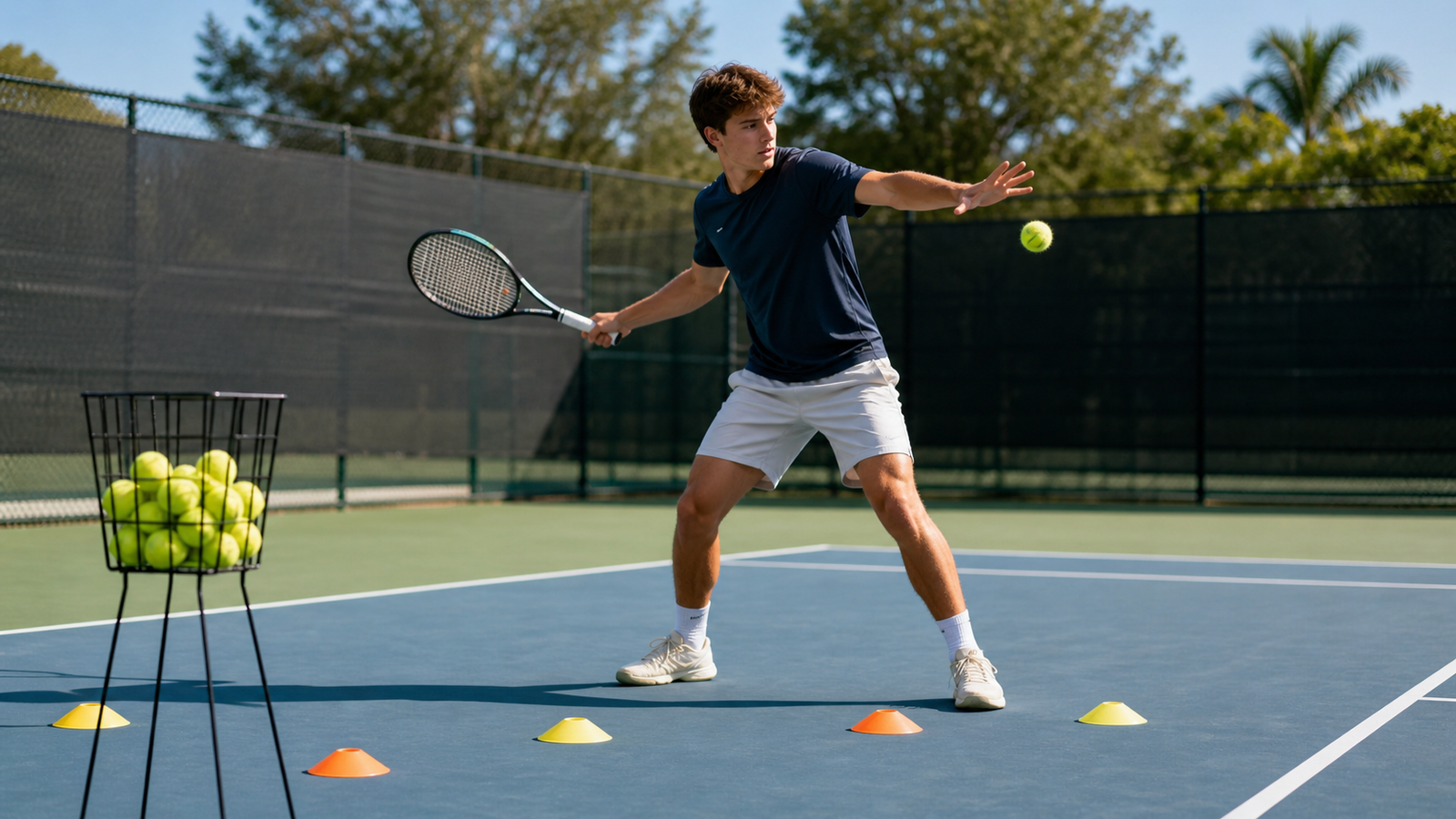
After shadow swings, drop-feed drills are one of the best next steps. Hold a ball in your non-dominant hand, drop it in front of you, and hit it after the bounce. This lets you control the feed and work on contact without needing a partner.
Use this drill first on the forehand side, then on the backhand side. Do not try to hit hard. Focus on meeting the ball in front, staying balanced, and finishing your swing properly. If your contact feels late or crowded, adjust your spacing. Small adjustments during solo tennis practice often make a huge difference once you return to rallying.
Drop-feeding also helps you understand rhythm. Many beginners swing too early, too late, or with poor spacing because everything feels rushed in live play. Controlled feeds help you slow the game down and learn the correct pattern.
Practice Against a Wall
Wall training is one of the most practical ways to improve through solo tennis practice because the wall gives instant feedback. If your swing is rushed or your contact is poor, the next ball will come back awkwardly. If your timing is clean, the rally becomes smoother and more controlled.
Start close to the wall and use gentle swings. Work on short forehands and backhands first. Then gradually move farther back as your control improves. Keep your knees slightly bent and recover to a balanced position after each shot. The goal is not power. The goal is rhythm, consistency, and proper technique.
If you want a session built specifically around wall training, you can naturally connect this article to your drills cluster by linking to Wall Practice Tennis Drills for Beginners (Improve Fast at Home).
Wall work is especially useful because solo tennis practice with a wall trains both technique and reaction. You still have to move, adjust, and recover, but in a controlled environment that allows lots of repetitions.
Break the Serve Into Smaller Parts
The serve is one of the best strokes to improve with solo tennis practice because you are fully in control of every repetition. You choose the starting position, the toss, the rhythm, and the target. That makes it easier to isolate problems.
Instead of trying to fix the whole serve at once, break it into parts. Practice your toss first. Then rehearse your trophy position. Then work on your upward swing path and follow-through. By separating the movement, you make the serve easier to understand and improve.
Many beginners struggle because their toss is inconsistent. If your toss is off, the entire serve becomes harder. Spending even 10 minutes of solo tennis practice just on toss accuracy can lead to major improvement. Stand on the baseline and try to place the toss in the same location every time. Once that becomes reliable, add the swing.
You can also connect this section naturally to your training cluster with an internal link to Serve Practice Drills for Beginners (No Coach Needed).
Use Footwork-Only Sessions
Not every good solo tennis practice session needs ball striking. Some of the biggest improvements come from footwork-only work. Better movement helps you reach the ball earlier, stay balanced through the shot, and recover more efficiently.
Mark a few spots on the ground with cones, tape, or even water bottles. Practice split steps, side shuffles, crossover steps, and recovery steps. Move to an imaginary forehand, recover to center, move to an imaginary backhand, and repeat. Add shadow swings if you want to make it feel more realistic.
This kind of practice trains your body to move better before you even hit the ball. For beginners, that is huge. Many technical problems are actually movement problems. Players blame their strokes when the real issue is poor positioning. Solo tennis practice that includes footwork can fix this faster than endless random hitting.
A natural internal link here is 10 Solo Tennis Drills to Improve Without a Partner, since that article can expand on movement-based and court-based solo work.
Train in Small Spaces When Needed
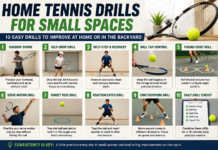
You do not always need a full court to improve. One of the best things about solo tennis practice is that it can be adapted to small spaces. A driveway, backyard, garage, or even a hallway can be enough for certain exercises.
In a small space, focus on shadow swings, short footwork patterns, split-step timing, reaction drills, grip changes, and serve toss work. You can also do mini self-feed drills if you have a safe area and soft balls. Even ten focused minutes can be useful if the drill has a clear purpose.
This matters because consistency usually beats intensity. You do not need the perfect setup every day. You just need regular, focused repetition. That is why solo tennis practice works so well for players with busy schedules.
A strong internal link opportunity here is Best Tennis Drills for Small Spaces (Home + Backyard).
Record Yourself and Review Your Form
One of the smartest ways to improve through solo tennis practice is to record short videos of your strokes. Many players think they know what they are doing, but video often tells a different story. You may notice that your backswing is too big, your contact point is too late, or your balance is off after every shot.
Set your phone on a tripod, bench, or fence and record a few forehands, backhands, serves, or footwork patterns. Then review the video with one question in mind: what is the main thing I should improve first? Avoid trying to fix everything at once. Choose one issue, work on it, and check again later.
Video review makes solo tennis practice more objective. Instead of guessing, you get visual proof of what is happening. This can speed up improvement significantly.
Build a Simple Session Structure
To get the most from solo tennis practice, structure matters. Random practice often feels productive, but it usually leads to slower progress. A simple plan keeps you focused and prevents wasted time.
A beginner session could look like this:
- 5 minutes of shadow swings
- 10 minutes of drop-feed forehands and backhands
- 10 minutes of wall practice or self-feed rally work
- 10 minutes of serve toss and serve motion work
- 5 minutes of footwork and recovery movement
This kind of structure helps you train multiple areas without losing focus. You do not need a long session every time. Even 20 to 30 minutes of focused solo tennis practice can be very effective if you stay intentional.
Common Mistakes to Avoid
Solo training works best when it is controlled and thoughtful. Here are a few common mistakes beginners should avoid:
Hitting Too Hard
Many players try to prove power instead of improving form. In solo tennis practice, control matters more than speed.
Repeating Bad Technique
Repetition only helps if the movement is correct. Slow down and make sure your mechanics are clean before increasing pace.
Ignoring Footwork
Good strokes start with good positioning. If you train the swing but not the movement, progress will be limited.
Practicing Without a Goal
Every session should have one main focus. That could be contact point, toss consistency, recovery steps, or balance.
Doing the Same Drill Every Time
Variety keeps training useful. Rotate between strokes, movement, wall work, and serve practice.
How Often Should You Practice Alone?
Beginners usually do well with solo tennis practice two to four times per week, depending on their schedule. The ideal amount depends on your goals, recovery, and match play frequency. Short, focused sessions several times per week are often better than one long, unfocused session.
If you are also playing with partners or taking lessons, solo training becomes a great supplement. Use it to reinforce what you are learning elsewhere. If you are not currently playing much with others, solo tennis practice can still keep your development moving forward until you get more live court time.
Final Thoughts
Solo tennis practice is one of the best ways to improve your technique faster because it gives you control over repetition, focus, and learning pace. You do not need a partner every day to become a better player. In many cases, practicing alone helps you understand your strokes more clearly and build better habits.
The key is to practice with purpose. Use shadow swings to clean up mechanics, drop-feed drills to improve contact, wall work for consistency, serve drills for repetition, and footwork sessions to sharpen movement. Keep your sessions simple, focused, and repeatable.
Over time, solo tennis practice can make your strokes more reliable, your movement more efficient, and your overall game more confident. Done the right way, it becomes one of the smartest tools in your tennis improvement plan.