
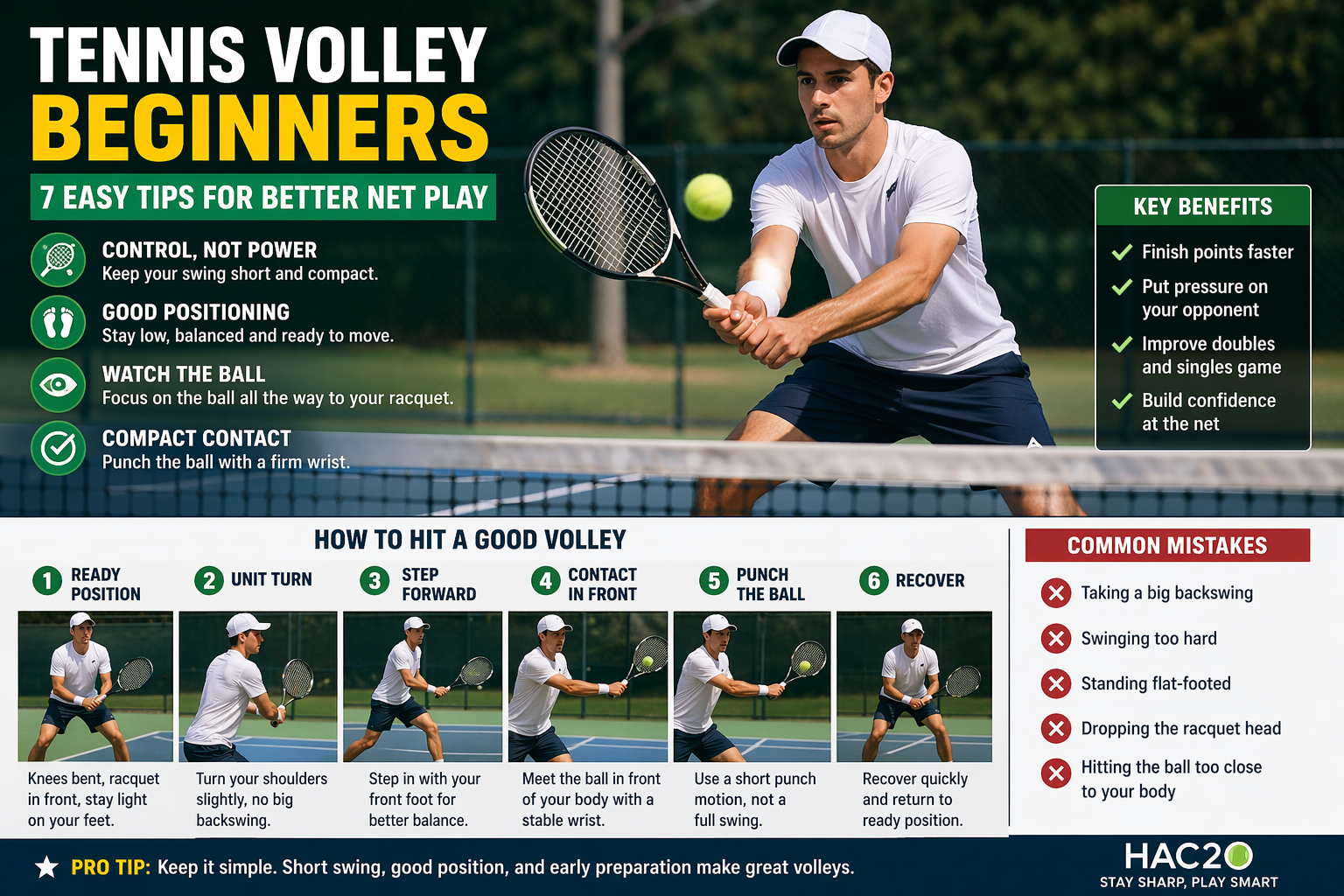
Tennis volley beginners often struggle at the net because volleys require quick reactions, simple technique, and good positioning. Tennis volley beginners often make the mistake of swinging too much instead of keeping the motion short and controlled. If you want to become a more complete player, learning how to volley in tennis is essential. Many beginners focus mainly on groundstrokes and serves, but strong net play can help you finish points faster, put pressure on opponents, and build confidence at the front of the court.
A volley is one of the most useful shots in tennis because it allows you to take time away from your opponent. Instead of letting the ball bounce, you meet it in the air and redirect it with control. For beginners, this may feel uncomfortable at first, but with the right technique, volleys become much easier and more natural.
If you are still learning your core stroke mechanics, it helps to first understand the basics of grip and shot preparation in our guide on how to hold a tennis racquet correctly.
What Is a Volley in Tennis?
A volley is a shot played before the ball bounces. It usually happens near the net, although advanced players can volley from other parts of the court too. The main goal of a volley is not to hit with huge power. Instead, it is to control the ball, keep it low, and place it where your opponent will struggle to reach it.
Volleys are important because they help you:
- finish points at the net
- react quickly in fast exchanges
- pressure your opponent
- improve all-around court skills
- become more confident in doubles and attacking play
For beginners, volleys can seem difficult because you have less time to react. But once you learn the proper stance, racquet position, and movement, volleying becomes much simpler.
If you want to review official tennis fundamentals and beginner development resources, the USTA also provides helpful tennis learning information.
When Should Beginners Use a Volley?
A volley is most effective when you move forward and attack a shorter ball. Instead of staying at the baseline, you come to the net and try to finish the point early. You may also volley during doubles, when quick reactions and net coverage are very important.
Beginners should use volleys when:
- the opponent hits a short ball
- they are moving toward the net after an approach shot
- they want to take time away from the opponent
- they are playing doubles and covering the front court
- they receive a weak floating ball near the service line
A volley is usually not the right shot when you are too far back or off balance. In those situations, it is often better to let the ball bounce and hit a groundstroke.
Why Tennis Volley Beginners Struggle at the Net
Many new players make the same mistakes at the net. They swing too much, stand too upright, hold the racquet too low, or wait too long to react. Unlike forehands and backhands, volleys need compact movement and quick preparation.
Some of the most common beginner problems include:
- taking a full backswing
- trying to hit too hard
- poor footwork
- late contact
- stiff hands and arms
- standing too close or too far from the net
These issues are normal in the early stages. The good news is that small technique changes can improve your volleys very quickly.
The Correct Ready Position for a Tennis Volley
Everything starts with your ready position. If your body is prepared early, the volley becomes much easier.
Here is the ideal ready position for beginners:
- keep your knees slightly bent
- stay on the balls of your feet
- hold the racquet out in front of your body
- keep both hands relaxed
- point the racquet head slightly upward
- keep your eyes focused on the ball
Your elbows should not be locked. Stay athletic and balanced so you can move quickly in any direction. Think of your ready position as active, not stiff.
Which Grip Should You Use for Volleys?
For most beginners, the continental grip is the best grip for volleys. This grip allows you to handle both forehand and backhand volleys without changing your hand position too much.
The continental grip is useful because it helps you:
- keep the racquet face stable
- react faster at the net
- switch easily between forehand and backhand volleys
- control low and high balls more effectively
If the continental grip feels awkward at first, that is normal. It often feels unfamiliar to beginners, but it becomes much more comfortable with practice. Building this grip foundation also helps with other shots later. You can improve your hand positioning by reviewing how to hold a tennis racquet correctly.
How to Hit a Forehand Volley
The forehand volley is played on your dominant side. It should be compact, controlled, and stable.
Follow these steps:
1. Start in ready position
Keep your racquet in front and stay balanced.
2. Turn your shoulders slightly
You do not need a big backswing. Just make a small shoulder turn.
3. Step forward
Move your front foot toward the ball as you make contact. This helps create control and natural power.
4. Keep the racquet face firm
Your wrist should stay stable. Do not flick at the ball.
5. Punch through the ball
Think of it as a short punch, not a swing. The movement should be compact and controlled.
6. Finish in front
Your follow-through should stay short. The racquet should remain in front of your body after contact.
The key idea is simple: block and guide the ball rather than swing hard.
How to Hit a Backhand Volley
The backhand volley follows many of the same principles, but on the other side of the body.
Here is how beginners should approach it:
1. Prepare early
As soon as you recognize the direction, turn your shoulders slightly.
2. Keep the racquet up
Do not let the racquet drop below the ball.
3. Step into the shot
Use your front foot to move through the volley.
4. Keep your wrist strong
A stable wrist helps you control the racquet face.
5. Use a compact punch
Again, do not swing like a groundstroke. Keep it short and controlled.
6. Recover quickly
After the volley, return to ready position for the next ball.
If you are still working on your backhand fundamentals from the baseline, it is helpful to also read how to hit a backhand in tennis.
The Most Important Volley Technique Tip: No Big Swing
One of the biggest improvements tennis volley beginners can make is learning to contact the ball in front of the body. This is the biggest lesson for beginners. A volley is not a forehand or backhand drive. You do not need a large backswing. The incoming pace of the ball already gives you enough energy. Your job is to control and redirect it.
Think about these words when volleying:
- short
- firm
- simple
- balanced
- controlled
The more you swing, the more errors you usually make at the net. A clean volley is built on timing and position, not force.
Footwork Tips for Better Net Play
For tennis volley beginners, good footwork is just as important as proper racquet position at the net. Footwork is one of the biggest reasons some beginners improve quickly at volleys while others struggle. Good footwork helps you get into position early and stay balanced during contact.
Important footwork tips include:
- take small adjustment steps
- stay light on your feet
- move forward with purpose
- keep your base stable
- recover after every shot
- avoid reaching too much with your arm only
A strong volley usually comes from getting your body behind the ball, not just sticking out the racquet.
Where Should You Aim Your Volleys?
Beginners often think they need to hit perfect winners from the net. That is not true. The smartest volley targets are usually simple and high percentage.
Good targets include:
- deep into the open court
- low at the opponent’s feet
- away from the opponent’s strongest side
- into the middle when under pressure
- angled only when you are in full control
Low volleys are especially effective because they force your opponent to hit upward, making their reply more difficult.
Common Mistakes Tennis Volley Beginners Make
Many tennis volley beginners struggle with confidence at the net, but simple repetition can improve control quickly. If your volleys are not working yet, one of these errors may be the reason.
Swinging too much
A large swing creates poor timing and less control.
Standing flat-footed
You need active feet to react quickly at the net.
Dropping the racquet head
If the racquet is too low, you lose control and struggle with fast balls.
Contacting the ball too close to the body
Try to meet the ball slightly in front.
Trying to hit too hard
Most volleys should be controlled, not crushed.
Not recovering after the shot
Good net players stay ready for the next ball immediately.
Many beginners repeat these same habits across multiple skills, so it is also worth checking the bigger picture in 15 best tennis drills for beginners, where you can build better control, movement, and touch through practice.
Practice Tips for Tennis Volley Beginners
The best way for tennis volley beginners to improve is to practice compact contact, balance, and recovery after each shot. You do not need advanced drills at first. Focus on consistency, clean contact, and body position.
Beginner volley practice ideas include:
- short forehand volley repetitions with a partner
- short backhand volley repetitions with a partner
- alternating forehand and backhand volleys
- coach or partner feeding easy balls at the net
- wall volleys from a short distance
- step-in volley practice for balance and control
Start slowly. Accuracy and technique matter much more than speed.
For official rules and broader tennis information, beginners can also visit the International Tennis Federation (ITF).
Should Beginners Rush the Net Often?
Not always. Coming to the net is useful, but timing matters. Beginners should not force net play on every point. It works best when you move forward behind a good approach shot or when your opponent gives you a short, weak ball.
Try to think of net play as a smart attacking option, not something you must do constantly. As your confidence improves, you will start to recognize the right moments more naturally.
Volleys in Singles vs Doubles
Volleys are important in both singles and doubles, but they tend to be even more important in doubles. In doubles, players are closer to the net more often, and quick exchanges happen regularly. This makes solid volley skills a major advantage.
In singles, volleys help you finish points and add variety. In doubles, they become one of the main weapons in your game.
So even if you mainly play singles right now, learning to volley early will help you in the long run.
How Long Does It Take to Learn Basic Volleys?
Most beginners can develop basic volley control fairly quickly if they practice consistently. The biggest improvements often come in the first few weeks because the changes are mostly technical and positional.
If you practice with good habits, you can usually build a much more confident volley by focusing on:
- ready position
- continental grip
- short punching motion
- stable wrist
- simple footwork
- recovery after contact
Consistency matters more than long sessions. Even short practice sessions can make a big difference.
Final Thoughts
Learning how to volley in tennis is one of the best ways to become a smarter and more versatile player. Strong volleys help you attack short balls, finish points at the net, and feel more confident in fast exchanges. For beginners, the key is to keep everything simple: use the right grip, prepare early, move your feet, and avoid taking a big swing.
Do not worry if volleys feel awkward at first. That is completely normal. With regular practice, your hands will become quicker, your contact will feel cleaner, and your net play will improve steadily over time. With regular drills, tennis volley beginners can develop much better touch and net play awareness.
To keep progressing, continue building your skills with how to hit a backhand in tennis and get more practice ideas from 15 best tennis drills for beginners.