
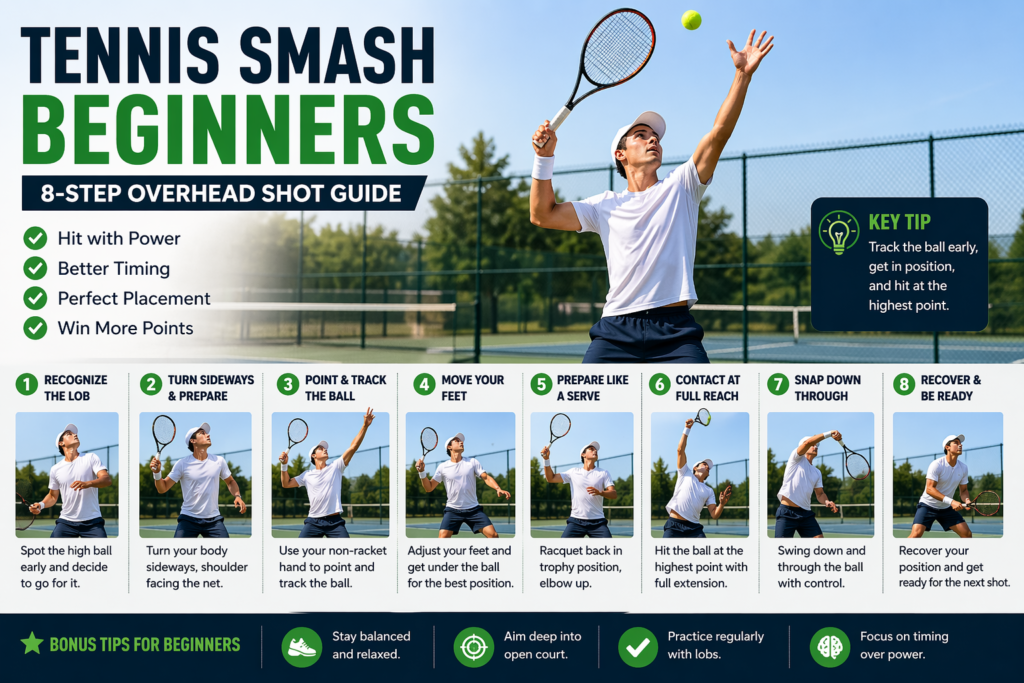
Tennis smash beginners often struggle with timing, footwork, and clean contact at first. If you are new to tennis, the smash can feel intimidating because the ball goes high, you have only a second to react, and many beginners either miss it completely or hit it into the net.
A tennis smash, also called an overhead shot, is usually played when your opponent sends the ball high into the air with a lob. Instead of letting the ball bounce, you move into position and hit it powerfully above your head. When done correctly, it is one of the most effective attacking shots in tennis.
In this beginner guide, you will learn what a tennis smash is, when to use it, how to set up correctly, the step-by-step technique, common mistakes, and simple tips to improve faster.
What Is a Tennis Smash?
A tennis smash is an overhead shot hit above your head, usually with a serve-like motion. It is most commonly used to finish a point when your opponent hits a weak lob.
Many beginners confuse the smash with the serve because the arm motion looks similar. The difference is that with a serve, you toss the ball yourself. With a smash, you react to a ball that is already coming toward you.
The smash is often played near the net, but sometimes you may have to move backward to hit it from deeper in the court.
Why the Overhead Smash Matters
Learning the overhead smash is important because it helps you:
- Finish points confidently
- Punish weak lobs
- Control the net better
- Prevent opponents from using easy defensive shots against you
- Build all-around attacking skills
If you are already learning net play, this shot becomes even more important. That is why it pairs naturally with your net game. Before working heavily on overheads, make sure you also understand the basics of how to volley in tennis, because volleys and smashes often appear together when you move forward to attack.
When Should You Use a Tennis Smash?
You should use a smash when:
- Your opponent hits a lob that stays high enough
- You have time to get under the ball
- The ball is above head level
- You can hit aggressively into open court
You should avoid smashing when:
- The ball is too far behind you
- You are off balance
- The sun or wind makes tracking difficult
- The ball is dropping too low, making a groundstroke a better option
A smart beginner does not try to smash every lob. Sometimes the better choice is to move back and let the ball bounce. This guide is designed to help tennis smash beginners build a more confident and reliable overhead shot.
Tennis Smash Beginners: Step-by-Step Basics
Tennis smash beginners often struggle with timing, balance, and clean contact at first. The most important thing for tennis smash beginners is getting into position early and tracking the ball with the non-dominant hand. Many tennis smash beginners make the mistake of swinging too hard instead of focusing on timing and footwork. For official beginner guidance, review the USTA and the ITF Rules of Tennis.
1. Recognize the Lob Early
The first key is reading the ball quickly. As soon as you see your opponent hit a high lob, turn your attention upward and decide whether you can take it as an overhead.
The earlier you recognize the lob, the more time you have to move into a strong position.
2. Turn Your Body Sideways
As soon as you know it is a smash opportunity, turn sideways rather than staying square to the net. Your shoulders should rotate so your non-dominant side points toward the ball.
For a right-handed player:
- Left shoulder points toward the ball
- Right arm prepares behind the body
For a left-handed player, reverse this.
This side-on setup helps you generate balance, power, and control.
3. Use Your Non-Dominant Hand to Track the Ball
One of the biggest secrets of a good overhead is using your non-dominant hand to point up at the ball. This helps with:
- Tracking the ball
- Keeping your head steady
- Improving balance
- Timing your contact point
Many beginners forget this step and lose the ball in the air.
4. Move Your Feet, Not Just Your Arm
The smash is not only about swinging hard. Footwork is critical.
Use small adjustment steps to move under the ball. Try to position yourself so the ball is slightly in front of your hitting shoulder at contact. If the ball gets behind your head, the shot becomes much harder.
A common beginner mistake is backpedaling wildly. Instead, try to turn and move with controlled crossover steps or shuffle steps, then adjust with smaller steps at the end.
5. Prepare the Racquet Like a Serve
Your racquet preparation should look similar to the trophy position in a serve. Keep the racquet up and ready rather than letting it drop too low.
Think of it like this:
- Eyes on the ball
- Non-dominant hand pointing up
- Hitting arm loaded and ready
This creates a simple, repeatable setup.
6. Contact the Ball at Full Reach
The ideal contact point is high and slightly in front of your body. Reach up fully, extend your arm, and hit the ball at the highest comfortable point.
Do not wait too long for the ball to drop too low. A higher contact point gives you:
- More power
- Better angle
- Cleaner technique
- More control
7. Snap Down Through the Ball
At contact, swing upward and through the ball, then let the racquet continue naturally. You do not need to force the shot too much. The goal is a clean, controlled overhead, not just raw power.
A good smash usually includes:
- Full extension
- Smooth acceleration
- Downward control
- Balanced follow-through
8. Recover After the Shot
After you hit the smash, recover quickly. If the ball comes back, you need to be ready for the next shot.
Beginners often admire their smash too long. In tennis, recovery is part of every stroke.
Basic Tennis Smash Technique Tips for Beginners
The most important thing for tennis smash beginners is getting into position early. If you are just starting, focus on these simple ideas:
Keep it simple
Do not overcomplicate the motion. Think: turn, point, move, reach, hit.
Prioritize positioning over power
Being under the ball correctly matters more than swinging hard.
Stay relaxed
Tension makes timing worse. A relaxed arm usually produces a cleaner smash.
Watch the ball all the way
Do not look up too quickly to see where the ball is going.
Aim safely
At beginner level, it is smarter to hit the smash deep into open court rather than trying to hit a highlight-reel winner.
Common Problems Tennis Smash Beginners Face
Backpedaling in panic
This is one of the most common errors. Instead of running backward off balance, turn sideways and move with control.
Letting the ball get behind you
If the ball passes behind your head, the smash becomes awkward and weak.
Swinging too hard
Many tennis smash beginners make the mistake of swinging too hard instead of focusing on timing. Trying to crush every overhead often leads to mishits. Clean contact matters more.
Not using the non-dominant hand
If you do not point up and track the ball, your timing usually suffers.
Poor footwork
One of the biggest improvements for tennis smash beginners comes from better footwork and earlier preparation. Many overhead errors are actually footwork errors, not swing errors.
Looking away too early
Keep your eyes on contact. Many beginners lift their head too soon.
Where Should Beginners Aim the Smash?
A smart target is usually:
- Deep into the open court
- Away from your opponent
- Safely inside the lines
If you are close to the net, you can angle the ball more sharply. But if you are still learning, choose percentage targets instead of risky ones.
A controlled smash to the middle of the court is often better than a missed winner attempt.
How to Practice the Overhead Smash
The best drills for tennis smash beginners are simple lob feeds and shadow swings. Beginners improve fastest when they practice in a simple progression.
1. Self-drop overhead drill
Stand near the service line, toss or drop the ball gently upward, and practice the motion.
2. Partner lobs
Ask a partner or coach to feed easy lobs so you can work on movement and contact.
3. Volley-to-smash drill
Start with a few volleys at the net, then finish with an overhead when the lob comes. This is great because it matches real match situations.
4. Shadow practice
Without a ball, rehearse:
- Side turn
- Non-dominant hand up
- Racquet preparation
- Contact and follow-through
Shadow practice helps build the correct pattern before adding pressure.
How the Smash Connects to Net Play
The overhead smash is not an isolated shot. It works together with your net game.
For example, when you move forward and pressure your opponent with volleys, they often respond with a lob. If you can handle that lob confidently, you become much more dangerous at the net. That is why beginners should learn both skills together.
If you have not already covered it, make sure to also study how to volley in tennis, because volley technique and smash technique support each other in real match play.
Beginner Mindset: Do Not Fear the Smash
A lot of new players fear overheads because they think they have to hit them perfectly. You do not.
At beginner level, success means:
- Getting into position early
- Making clean contact
- Hitting the ball in court
- Staying balanced
You do not need a professional-level overhead right away. A simple, reliable smash is already a big advantage.
Final Thoughts
If tennis smash beginners practice these steps regularly, the overhead shot becomes much more confident and consistent. The tennis smash and overhead shot can become one of your most effective weapons if you build it the right way. Start by recognizing the lob early, turning sideways, tracking the ball with your non-dominant hand, and using your feet to get into position. From there, focus on clean contact and controlled placement rather than trying to overpower every shot.
For beginners, the most important thing is repetition. Practice the setup, movement, and timing regularly, and the shot will start to feel much more natural. Once you combine a solid smash with better net skills, you will become far more confident when moving forward in points.