
Tennis is one of the most exciting and rewarding sports you can learn—whether you want to play for fun, fitness, or future competition. As a beginner, it can feel overwhelming with all the rules, scoring terms, and techniques, but don’t worry—this guide breaks everything down in a simple, friendly way to help you get started with confidence.
By the end of this guide, you’ll know the essential rules, how scoring works, what equipment you need, and how to start playing your first real game.
1. Introduction: Why Tennis Is a Great Sport to Start With
Tennis isn’t just a game—it’s a lifelong sport that improves your physical health, coordination, mental strength, and confidence. It’s suitable for all ages and fitness levels, and you can practice almost anywhere, from local courts to your own backyard.
Why tennis is perfect for beginners:
-
Improves full-body fitness – cardio, strength, flexibility, and balance
-
Boosts mental focus and discipline
-
Great for socializing and making new friends
-
Can be played casually or competitively

If you’re just starting your tennis journey, this guide will help you build a solid foundation and avoid confusion—so stick with it till the end!
2. Tennis Basics & Equipment Beginners Need
Before stepping on the court, you need to know the basic equipment and why choosing the right beginner gear makes learning easier. The good news? You don’t need expensive equipment to start.
Essential Tennis Equipment:
| Item | Why You Need It |
|---|---|
| Tennis Racquet | Your main tool—choose a beginner-friendly one |
| Tennis Balls | Practice and match play |
| Tennis Shoes | Designed for court movement & safety |
| Comfortable Clothing | Allows easy movement |
| Water Bottle & Towel | For hydration and comfort |
Choosing Your First Tennis Racquet (Beginner Tips)
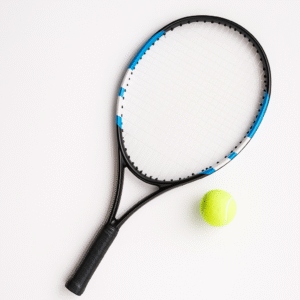
The racquet you choose affects your control, power, and comfort. For beginners, the best racquet is one that is:
-
Lightweight (9–11 oz)
-
Oversized head (100–108 sq. inches) for a larger sweet spot
-
Medium grip size for comfort and injury prevention
Bold Tip: A light, oversized racquet helps beginners hit cleaner shots and learn faster.
🔍 Beginner Racquet Recommendations (Subtle Mentions)
-
Wilson Clash 100
-
Babolat Boost Aero
-
Head Ti.S6
(Affiliate links will be inserted later.)
✅ Mini Product Box: Best Overall Beginner Racquet
Best for Beginners: Wilson Clash 100
Why we like it:
✔ Easy to control
✔ Comfortable for the arm
✔ Large sweet spot to reduce misses
Ideal for: Beginners who want fast improvement and comfort.

Other Basic Gear Beginners Should Consider
-
Tennis shoes: Choose shoes designed for tennis—not running shoes—to avoid injury and slipping.
-
Tennis balls: Start with pressureless or beginner low-compression balls to learn control faster.
Bold Tip: Avoid using regular high-speed balls at first—they bounce fast and are harder to control.
3. Rules of the Game (Beginner-Friendly Breakdown)
Learning the basic rules will help you understand how the game works and feel confident stepping onto the court. Tennis can look complicated at first, but once you learn the flow of a point, a game, and a match, it becomes simple.
🎯 Objective of the Game
The goal in tennis is to hit the ball over the net and into your opponent’s court in a way that they cannot return it.
A point continues until:
-
The ball bounces twice on one side
-
A player hits the ball out of bounds
-
A player hits the net and it doesn’t go over
🤝 Singles vs. Doubles
| Format | Players | Court Size |
|---|---|---|
| Singles | 1 vs 1 | Narrow court (inner sidelines) |
| Doubles | 2 vs 2 | Wider court (outer alleys included) |
Bold Tip: If you’re a beginner, start with singles—it’s easier to focus on your movements and shots.
🔽 Basic Flow of a Tennis Point
-
Serve starts the point
-
Opponent returns the serve
-
Rally continues until one player wins the point
❌ Faults Beginners Should Know
-
Fault: Serve lands outside the service box
-
Double Fault: Two failed serves → opponent wins the point
-
Foot Fault: Server steps on the baseline during serve
4. Tennis Scoring System (Explained Simply)
Tennis scoring confuses most beginners at first. Don’t worry—this section explains it in a simple way so you’ll finally “get it.”
🎾 Points System
Instead of counting 1, 2, 3, 4, tennis uses these terms:
| Score Term | Meaning |
|---|---|
| 0 | Love |
| 1 point | 15 |
| 2 points | 30 |
| 3 points | 40 |
| 4 points | Game won |
Example: If you score two points, the score is 30–Love.
Bold Memory Trick:
Think: 0–15–30–40–Game.
Just memorize that order—it becomes natural after a few matches.
🤝 Deuce + Advantage (Close Game Rule)
If both players reach 40–40, it’s called Deuce.
From there:
-
Win 1 point → Advantage
-
Win next point → Game won
If the player with Advantage loses the next point, it goes back to Deuce again.
🧱 How Games, Sets & Matches Work
| Term | What It Means |
|---|---|
| Game | Smallest scoring unit |
| Set | First to win 6 games (must win by 2) |
| Match | Usually best of 3 sets |
Example Match Format (Most Common)
-
Best of 3 Sets
Win 2 sets → win the match.
5. Tennis Court Types & Surfaces (Which One Should Beginners Start On?)
The type of surface you play on affects how the ball bounces, how you move, and the style of play you’ll develop. Knowing the differences helps you adapt faster and choose the best court for your practice.
### Different Tennis Court Surfaces Explained
There are four main types of tennis courts used around the world, each offering a unique playing experience.
#### Hard Court: Best Surface for Beginners (Most Common in the US)
Hard courts are the most beginner-friendly and widely available surface in the United States. They provide a consistent bounce, making it easier to learn timing and control.
Characteristics:
-
Offers medium–fast speed and consistent bounce
-
Easy to move and learn different playing styles
-
Less physically demanding than clay or grass
Why it’s great for beginners:
-
Predictable ball bounce helps you learn proper footwork and timing
-
Most public courts in the US are hard courts, so access is easy
-
Balanced for developing both offense and defense
Bold Tip: Start training on hard courts to build solid fundamentals before switching to other surfaces.
#### Clay Court: Slower Pace & More Rally-Based
Clay courts are more common in Europe and Latin America, but some U.S. clubs have them too. Clay has a slower bounce and is great for developing stamina and consistency.
Characteristics:
-
Slow ball speed — more time to react
-
Higher bounce
-
Encourages long rallies and defensive play
Benefits for players:
-
Improves endurance and patience
-
Helps develop topspin and footwork
-
Encourages strategic play
Note: Footwork is harder on clay due to sliding, so it’s less ideal for complete beginners.
#### Grass Court: Fastest Surface & Low Bounce
Grass courts are the fastest surface, with low ball bounce and quick rallies. They’re less common due to maintenance costs.
Characteristics:
-
Very fast with low, unpredictable bounce
-
Points are shorter
-
Favors aggressive, serve-and-volley players
Best for:
Developing reflexes, fast decision-making, and net play.
Not ideal for beginners because the ball bounce is harder to judge.
#### Carpet or Synthetic Surface: Indoor Matches
Carpet courts are used mainly indoors and are less common for beginners. The bounce is faster than clay but softer on joints than hard courts.
Which Surface Should a Beginner Practice On?
| Rank | Surface | Beginner Rating | Why |
|---|---|---|---|
| ✅ #1 | Hard Court | ★★★★★ | Balanced, accessible, best for fundamentals |
| #2 | Clay | ★★★★☆ | Great for strategy & stamina |
| #3 | Grass | ★★☆☆☆ | Harder to adapt to |
| #4 | Carpet | ★★☆☆☆ | Less common |
Conclusion:
If you’re in the U.S., start with hard courts to build your foundation—it prepares you for all other surfaces.