
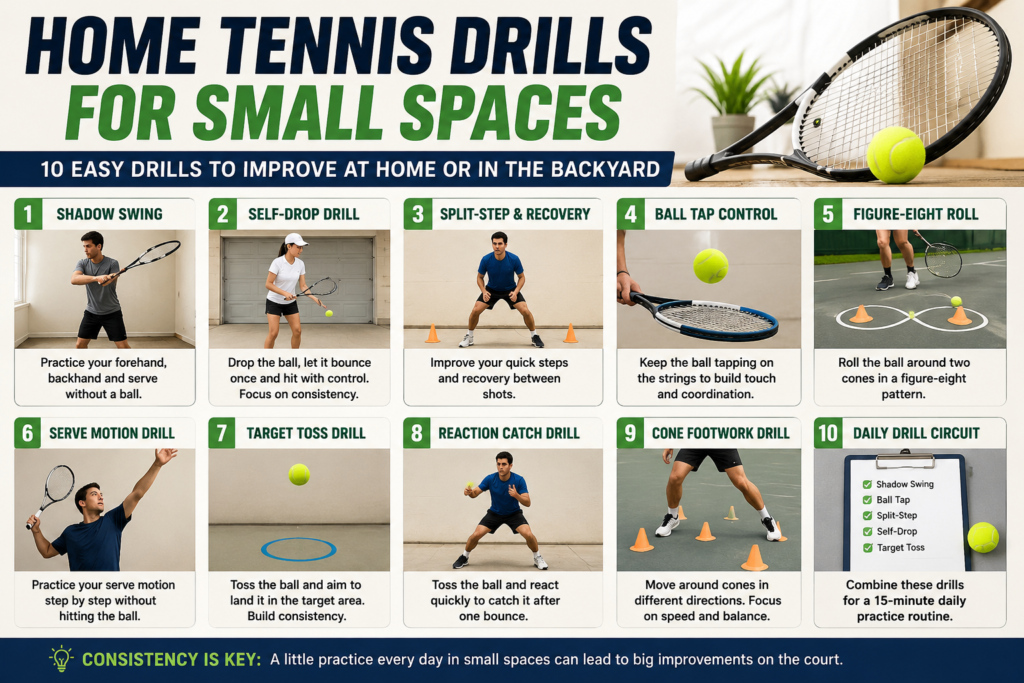
If you do not have access to a full court, that does not mean your progress has to stop. Some of the most useful improvements in tennis come from repetition, balance work, timing, and clean movement patterns. That is exactly why home tennis drills can be so effective for beginners. With a small open area, a wall, a driveway, a garage, or a backyard, you can still build better control, stronger habits, and more confidence.
Many new players assume they need a court partner or a coach every time they want to practice. In reality, smart home tennis drills can help you improve hand-eye coordination, footwork, swing rhythm, contact point awareness, and overall feel for the ball. They are also ideal for busy players who want to train consistently without spending extra time traveling to a court.
This guide covers the best small-space practice ideas for beginners, how to do them safely, and how to turn limited room into productive training. If you want more independent practice ideas, see our guide on 10 Solo Tennis Drills to Improve Without a Partner. And if you do have access to a wall sometimes, our article on Wall Practice Tennis Drills for Beginners (Improve Fast at Home) is the perfect next step.
Why Small-Space Tennis Training Works
The biggest benefit of home tennis drills is consistency. Tennis improvement comes from doing the basics well over and over again. Even if you cannot hit full-power groundstrokes, you can still train the foundations that matter most:
- balance
- swing control
- footwork
- timing
- ball tracking
- coordination
- racket feel
For beginners, these are not small things. They are the core of future improvement. A player who practices regularly in a small space often develops better habits than someone who only plays once in a while on a full court.
Another reason home tennis drills work is that they remove pressure. You can focus on one movement at a time without worrying about winning points or keeping up with a partner. That makes learning easier and less frustrating.
Before You Start: Set Up a Safe Practice Space
Before doing home tennis drills, make sure your area is safe and realistic for movement. You do not need a huge space, but you do need enough room to swing under control and move without slipping.
A good small-space setup usually includes:
- a flat surface
- enough overhead room for light shadow swings
- no breakable objects nearby
- proper tennis shoes or grippy athletic shoes
- a few balls, cones, or markers
If you are doing backyard tennis practice, check the surface first. Grass, uneven tiles, loose gravel, or wet concrete can make practice unsafe. It is better to reduce speed and focus on control than to force aggressive movement in a risky area.
1. Shadow Swing Repetition Drill
One of the simplest home tennis drills is shadow swinging. This means practicing your forehand, backhand, and ready position without hitting a ball.
Stand in your small practice area and rehearse:
- split step
- turn
- swing path
- finish
- recovery
Do 10 to 15 slow forehands, then 10 to 15 backhands. Focus on balance and smooth mechanics, not speed. This drill helps beginners build muscle memory and understand how the stroke should feel.
For very limited spaces, shadow work is one of the safest and smartest home tennis drills because it teaches movement patterns without needing much room.
2. Self-Drop Forehand and Backhand Drill
This is one of the best home tennis drills for learning clean contact. Drop the ball yourself, let it bounce once, and hit it gently into a safe target area or simply guide it upward with controlled contact.
The goal is not power. The goal is:
- meeting the ball in front
- keeping your head still
- finishing your swing with balance
You can alternate forehands and backhands. In backyard tennis practice, this drill works especially well when you have a little more forward space to let the ball move naturally.
Start with 20 controlled reps on each side. As you improve, try aiming toward a chalk box, a cone, or a marked landing zone.
3. Mini Split-Step and Recovery Drill
Tennis is not just about strokes. Good movement matters just as much. That is why movement-based home tennis drills are so valuable in small spaces.
Set two markers about two or three steps apart. Start in the middle in ready position. Do a light split step, shuffle to one side, recover to center, then repeat on the other side.
This teaches:
- quick first movement
- athletic posture
- recovery habits
- balance under control
Even a narrow space is enough for this drill. If you stay disciplined, home tennis drills like this can improve court movement without needing a full court.
4. Ball Tap Control Drill
This is a classic coordination drill and one of the easiest home tennis drills for beginners. Tap the tennis ball upward using the strings of your racket and try to keep it going as long as possible.
You can do this:
- at waist height
- with forehand side only
- with backhand side only
- by alternating sides
This drill improves touch, focus, and racket control. It may look simple, but it builds a better feel for the ball. During backyard tennis practice, this is a great warm-up before more active drills.
Try reaching 25 taps, then 50, then 100. Small daily improvements add up fast.
5. Figure-Eight Ball Roll Drill
For this drill, place two balls, cones, or shoes on the ground a short distance apart. Use your racket to roll a ball around them in a figure-eight pattern.
This is one of those home tennis drills that seems basic but teaches important skills:
- soft hands
- racket-face awareness
- concentration
- control under movement
Beginners often grip the racket too tightly. This drill encourages a lighter touch and better feel. It is also excellent for younger players and anyone doing technical backyard tennis practice at home.
6. Serve Motion Without Ball Contact
If your ceiling or outdoor space allows it, serve practice without hitting the ball can be very useful. Among home tennis drills, this is one of the best for learning rhythm.
Work on:
- stance
- toss arm lift
- shoulder turn
- trophy position
- smooth follow-through
Do not rush. Just repeat the service motion slowly and correctly. If you have enough space outside, you can add a gentle toss and catch instead of a full strike. This makes backyard tennis practice especially useful for beginners who need to build serve confidence before trying full-speed serves.
7. Target Toss Drill
Toss consistency is a major part of serving, and it can absolutely be trained in small spaces. Put a marker on the ground where you want the toss to land. Then practice tossing the ball so it rises straight and drops near the target.
This is one of the most overlooked home tennis drills, yet it can fix a major beginner problem. A poor toss ruins serve timing, balance, and confidence. A steady toss creates a much cleaner motion.
Practice 20 to 30 tosses at a time. If you are doing backyard tennis practice, use this drill often before any serve work.
8. Reaction Catch Drill
Stand in ready position and toss the ball lightly against a wall or upward in front of yourself, then react quickly and catch it after one bounce. You can also have a family member or friend feed random tosses for you to track.
This drill improves:
- reaction speed
- eye tracking
- first movement
- athletic readiness
Not all home tennis drills need a full swing. Some of the best ones simply train the body to read and react faster.
9. Cone Patterns for Footwork
If you have a little extra space, set up three or four cones and move through simple patterns:
- forward and back
- side to side
- diagonal shuffle
- in-and-out split step
This is one of the most useful home tennis drills for players who feel slow getting to the ball. Focus on staying low, keeping your feet active, and recovering to balance. For structured improvement, pair this with our guide on Wall Practice Tennis Drills for Beginners (Improve Fast at Home) when you want to combine movement with actual ball contact.
10. Daily Home Drill Circuit
The best results come when home tennis drills are organized into a repeatable routine. Here is a simple 15-minute circuit:
Minute 1–3: shadow swings
Minute 4–6: ball tap control
Minute 7–9: split-step and recovery
Minute 10–12: self-drop contact drill
Minute 13–15: toss or reaction drill
This kind of short routine makes home tennis drills easier to stick with. It also helps beginners train more often without feeling overwhelmed. Before starting your short routine, it also helps to follow a simple 10-minute tennis warm-up so your body is ready for movement and repetition.
Common Mistakes to Avoid
Small-space training works best when you stay realistic. Do not make these mistakes:
Trying to hit too hard
In tight spaces, controlled technique matters more than power.
Ignoring footwork
Many players focus only on swings, but footwork is one of the biggest benefits of home tennis drills.
Using bad surfaces
Safe movement always comes first, especially during backyard tennis practice.
Practicing carelessly
Repetition only helps when it is done with focus.
Skipping progression
Start simple, then add more challenge over time.
If you want to keep building your skills between court sessions, these USTA tennis improvement tips can also help you practice smarter and stay consistent.
Final Thoughts
You do not need a full court to improve. With the right plan, home tennis drills can help beginners develop cleaner technique, sharper movement, and better confidence between court sessions. In fact, practicing in a small space often forces you to slow down and focus on the exact fundamentals that matter most.
The key is to stay consistent. A short daily session of home tennis drills can be more useful than occasional random practice. And if you have a little outdoor room, backyard tennis practice gives you even more ways to build timing, control, and comfort with the racket.
Start with a few drills from this guide, keep your sessions simple, and repeat them weekly. Over time, those small-space habits can make a big difference when you step onto a full court.
For more independent beginner training, read 10 Solo Tennis Drills to Improve Without a Partner and Wall Practice Tennis Drills for Beginners (Improve Fast at Home) next.